Fossil of 'unconquered female warrior' dinosaur with long claws found in UK museum drawer after 100 years
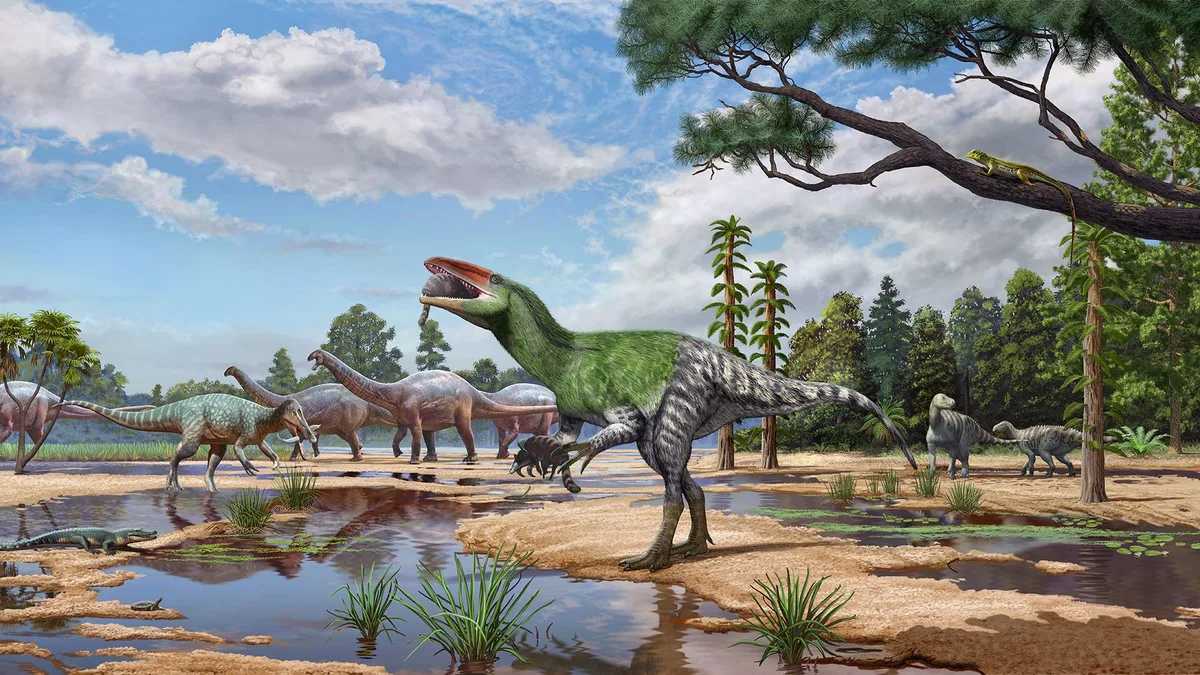
A fossil that sat in a museum collection for over a century is a previously unknown species of predatory dinosaur, researchers have found.
The discovery could help scientists solve a longstanding mystery about how some of the Cretaceous period 's most formidable hunters spread around the globe.
The dinosaur lived on what is now the Isle of Wight in southern England about 120 million years ago.
It belonged to a group of two-legged carnivores called megaraptors , which are related to tyrannosaurs .
But unlike tyrannousars, megaraptors are thought to have relied on their powerful arms and large curved claws to attack prey and defend themselves.
The newly identified species was described in an Oct.
14 study in the journal Royal Society Open Science .
It is the first megaraptor identified in Europe, filling an important gap in the fossil record of a group whose evolutionary history remains poorly understood.
"It is a real mystery that this fossil was overlooked for so long, sitting in a drawer for nearly 100 years," study first author Cassius Morrison , a researcher in the Department of Earth Sciences at University College London (UCL) said in a statement .
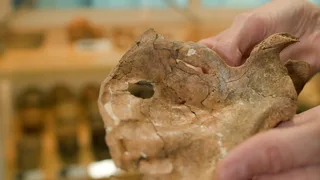
"Lots of bones are found on the Isle of Wight — who knows what else is waiting to be discovered." Unconquered female warrior dinosaur The discovery of the megaraptor began in 1924, when an amateur fossil collector discovered a dinosaur skull fragment on the Isle of Wight.
The specimen eventually entered the collections of London's Natural History Museum, but it was largely forgotten.
Recently, researchers revisited the fossil as part of a study on dinosaur braincases.
To identify the animal, the researchers used micro-CT scanning to examine the fossil's internal structure and build detailed 3D digital models of the space that once held the dinosaur's brain.
The researchers then compared the animal's anatomy with that of other meat-eating dinosaurs, including tyrannosaurs, spinosaurs and other theropods (the group of two-legged, mostly meat-eating dinosaurs).
5News aggregated this summary from the outlet’s public feed. The full article, with all the context, is on www.livescience.com — the content belongs to Live Science.