LAEL BETHLEHEM | New agency aims to boost local infrastructure partnerships
Each day we learn more about the dire state of the City of Johannesburg’s finances.
There is no doubt that the city is bankrupt and is cutting services in every direction. But this merely describes the income statement ― its revenue and expenditure ― and its ability to meet its present financial obligations. An even larger problem lurks beneath the surface.
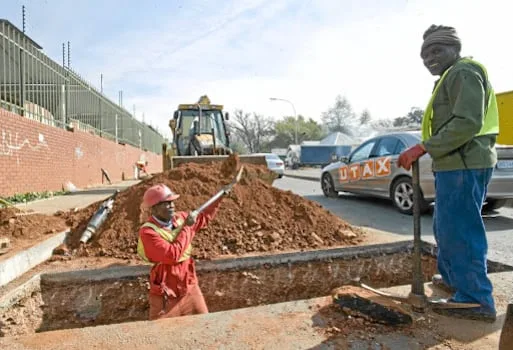
The city’s balance sheet ― its underlying assets ― are being starved of investment. These are the pipes, water treatment plants, electricity substations, cables, roads, bridges and buildings on which the city depends.
These assets are the bedrock of Johannesburg’s future earnings because they form the basis of the rates and tariffs the city charges its residents. More importantly, they are the basis of life in Johannesburg, the assets on which we all depend for the running of households and the functioning of the economy.
Over the past 15 years the city has reduced the capital (or investment) portion of its budget from 15% to 7%, allowing personnel and other operating costs to crowd out infrastructure investment. This week we learnt that by May this year (the 11th month of its financial year) the city had spent only 50% of that reduced capital budget.
We can therefore expect that Johannesburg will spend little more than half of the 7% set aside for capex in the 2026 financial year, meaning some 96% of the budget will be spent on operating costs. To put this in context, Johannesburg will spend about R5bn on infrastructure while Cape Town spends closer to R12bn. This is the key source of Johannesburg’s water leaks and power outages.
This problem is unfortunately not limited to Johannesburg. All of the metros besides Cape Town have steadily reduced their capital spending relative to opex. Between 2010-23 capital expenditure by South African large cities declined by 40% in real terms, while personnel spending grew 68%. A similar pattern emerges for the local government system as a whole.
The municipal infrastructure backlog now stands at R1-trillion. This is a massive challenge and national-scale fiscal risk.
The problem can be addressed in part by municipalities shifting their expenditure back towards capital spend, and by ring-fencing their electricity and water revenues and investing them back into the services. But it will not be nearly enough. We need public-private partnerships at the local level to invest in infrastructure. We have the pools of private capital, skills and equipment to address the problem but we don’t call on them sufficiently.
In 1998 the national government established the Municipal Infrastructure Investment Unit to focus on mobilising and regulating private investment in municipal infrastructure. It was run by a number of talented public servants, including Monhla Hlahla, and worked closely with the Development Bank of Southern Africa to initiate and deliver large-scale municipal projects.
5News aggregated this summary from the outlet’s public feed. The full article, with all the context, is on www.businesslive.co.za — the content belongs to Business Day.