Alice Duncan-Kemp was an empathetic observer of Mithaka culture, but her legacy is complicated
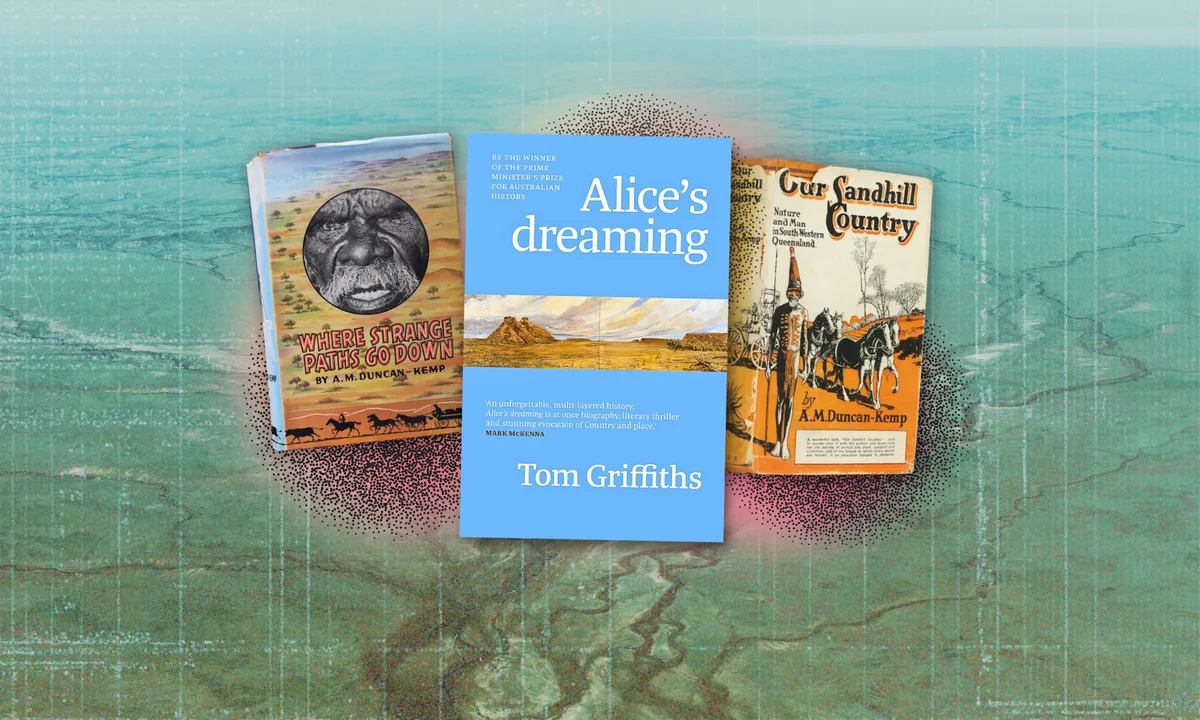
Mark Kolbe/Getty Images, Blank Inc., Angus & Robertson, W.R.
Smith & Paterson, The Conversation Alice’s dreaming is centrally about the childhood, memories and writings of Alice Duncan-Kemp (1901-1988), who grew up on a pastoral property named Mooraberrie in the first decades of the 20th century.
Mooraberrie was a vast sheep and cattle station located in the Channel Country between Birdsville and Windorah in inland south-western Queensland.
A 2015 native title determination recognised Mithaka people as the traditional owners of the region.
Duncan-Kemp published four books in her lifetime and another was published posthumously.
All of these works drew on a childhood spent in intimate contact with Mithaka people.
Her extraordinarily detailed and empathetic observations formed part of the documentary basis for the 2015 native title determination.
Review: Alice’s dreaming – Tom Griffiths (Black Inc.) What then of the word “dreaming” in Tom Griffiths’ title? According to the historian Patrick Wolfe , the word “dreamtime” entered the Australian lexicon via the early anthropological research collaboration between Frank Gillen , the postmaster at Mparntwe (Alice Springs), and Baldwin Spencer , a professor of biology at the University of Melbourne.
Their famed partnership resulted in a huge collection of objects, images and films, which has been digitised .
Channel Country, Cooper Creek, Windorah, Queensland.
Stuart Watt, via Wikimedia Commons , CC BY The Arrernte term “alcheringa” was translated by Gillen as the “dream-times”: a long-distant epoch in which the world was created and rules of conduct were laid down.
Wolfe was critical of the generalisation of Spencer and Gillen’s notion of the “dream-times”.
He showed that dreams were a counterpoint to European scientific rationalism; the connection between “dreaminess” and Aboriginal people reinforced some of the racist presumptions of both 19th-century anthropology and the popular imagination.
The mid-20th century anthropologist W.E.H.
5News aggregated this summary from the outlet’s public feed. The full article, with all the context, is on theconversation.com — the content belongs to The Conversation Australia.





