Earth’s oldest evidence of life is written in stone – but it’s at risk of disappearing
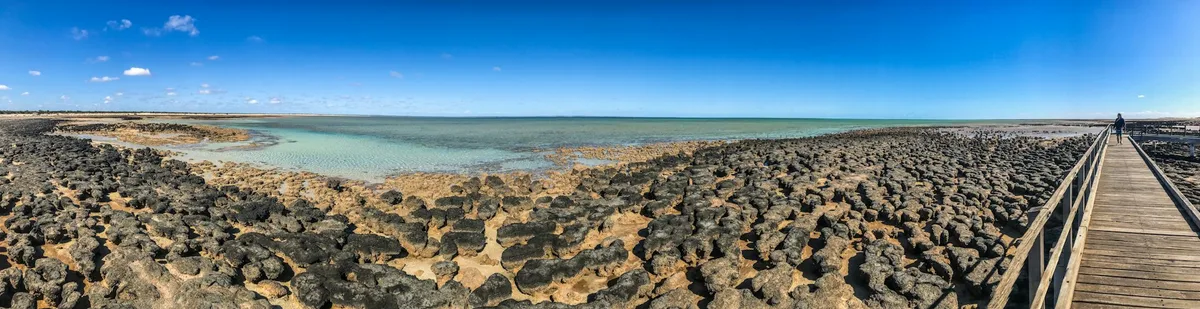
Stromatolites at Hamelin Pool, Shark Bay, viewed from the boardwalk.
Heidi Allen Today, our planet is teeming with life, but it has not always looked the same.
Long before forests reached skyward, animals walked on land, and the rise and fall of dinosaurs, our planet was shaped by a much smaller, more unassuming form of life.
And we can still find traces of it today.
These ancient fossils, the earliest visible evidence of life on Earth, are known as microbialites .
Western Australia contains an extraordinary record of microbialites: from the oldest known examples, preserved in rocks almost 3.5 billion years old in the Pilbara, to living examples in the UNESCO World Heritage area of Shark Bay .
Our review of 50 years of microbialite research in Western Australia , published today in the journal Alcheringa, summarises what this archive can tell us about the evolution and resilience of life on Earth.
Despite a fossil record that spans billions of years, microbialites are surprisingly fragile.
Fossil sites remain vulnerable to over-collection and degradation, while living microbialites are facing growing pressures.
At sites such as Lake Clifton and Shark Bay, some events may have already caused irreparable damage.
One such example was in May 2024 , when dozens of aurora chasers trampled 2,000-year-old thrombolites in a restricted area at Lake Clifton.
Fossil microbialites preserved in rocks almost 3.5 billion years old in Western Australia’s Pilbara region.
Heidi Allen Earth’s oldest evidence of life Microbialites are mounded structures that come in many shapes and sizes.
They form when communities of microbes either precipitate minerals, or trap and bind sediment.
5News aggregated this summary from the outlet’s public feed. The full article, with all the context, is on theconversation.com — the content belongs to The Conversation Australia.