Astronomers pinpoint the origin of a 10 billion-year-old millisecond signal from space
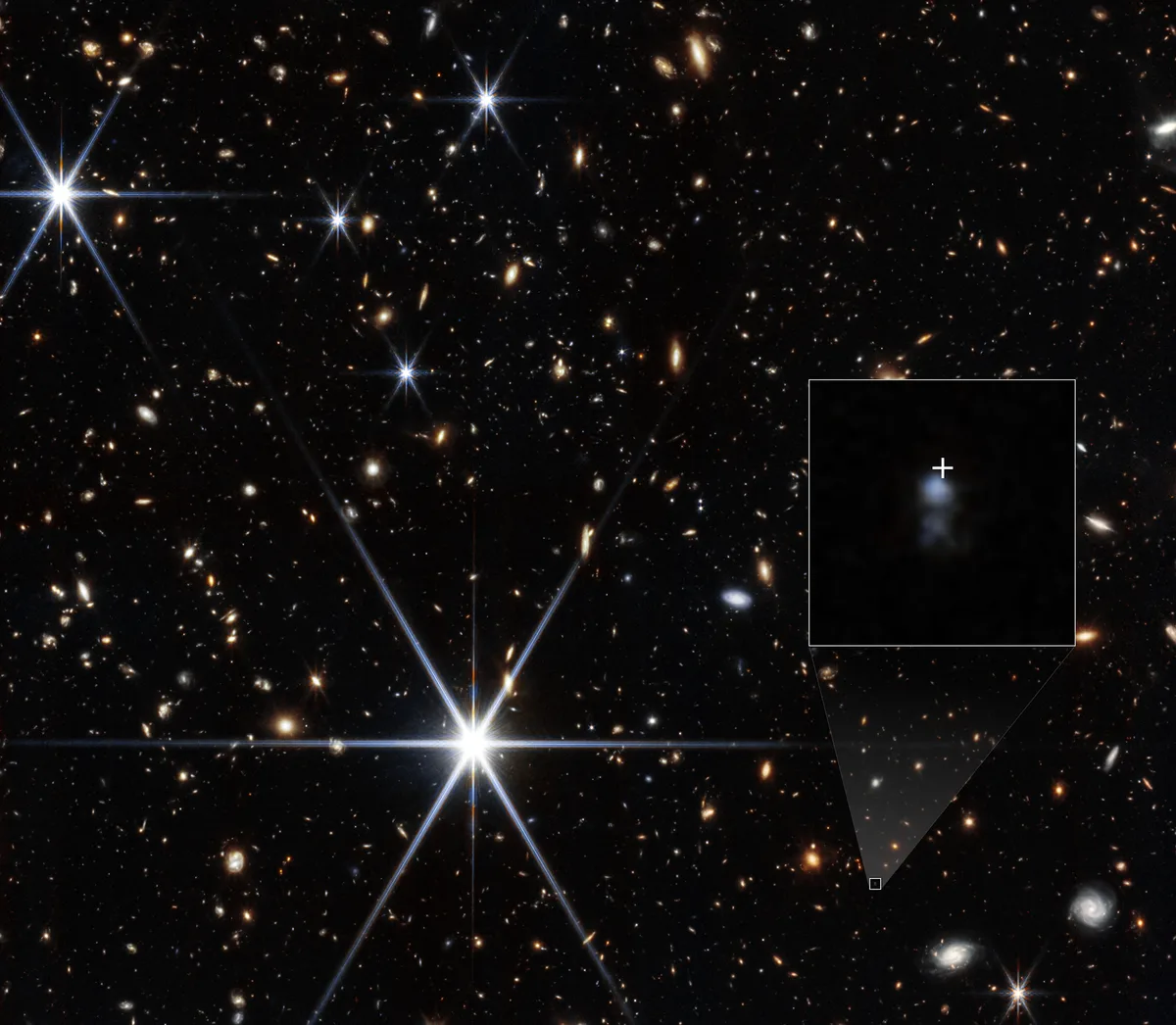
NASA, ESA, CSA, STScI, Themiya Nanayakkara (USYD), Joseph DePasquale (STScI) , CC BY More than 10 billion years ago, something in a distant galaxy gave off an incredibly bright burst of radio waves which lasted just a few milliseconds.
In new research published today in Science , our team tracked it back to its origin in a small galaxy filled with many young stars, when the universe was only one-fifth of its current age.
Fast radio bursts like this one are a mystery scientists have been trying to unravel for almost 20 years since they were first discovered.
Our discovery is the most distant such burst whose host galaxy has yet been identified.
Finding a radio signal from 10 billion years ago We detected the burst, dubbed FRB 20240304B, with the MeerKAT radio telescope in South Africa, using a system called MeerTRAP which is designed to catch fast-changing transient radio signals from space in real time.
The different frequencies of the radio burst arrived at slightly different times.
We call this effect “dispersion”, and it happens because the signal has travelled through a lot of electrically charged material in space on its journey to Earth.
By measuring the amount of dispersion, we can tell how much of this material the signal has passed through – which in turn lets us calculate how far the signal has travelled and how far away from us it was created.
The FRB 20240304B burst showed a large amount of dispersion, which suggested it was probably coming from a great distance.
We were also able to pinpoint its position on the sky.
But when we looked at that position with large ground-based telescopes like the Keck Telescopes , we couldn’t see a host galaxy.
The galaxy was simply too faint.
So we turned to the James Webb Space Telescope ( JWST ).
The space telescope’s infrared camera revealed a tiny galaxy very close to the position of the fast radio burst.
5News aggregated this summary from the outlet’s public feed. The full article, with all the context, is on theconversation.com — the content belongs to The Conversation Australia.





