4,000-year-old rock painting in Indonesia offers clues to one of humanity’s greatest migrations
Shimona Kealy Some 4,200 years ago, people started to leave what is now Taiwan to migrate to the thousands of islands to the south, spanning as far west as Madagascar in the western Indian Ocean and as far east as Rapa Nui (Easter Island) in the eastern Pacific Ocean.
We can trace this migration through the way language spread, creating the largest-scale language dispersal in prehistory .
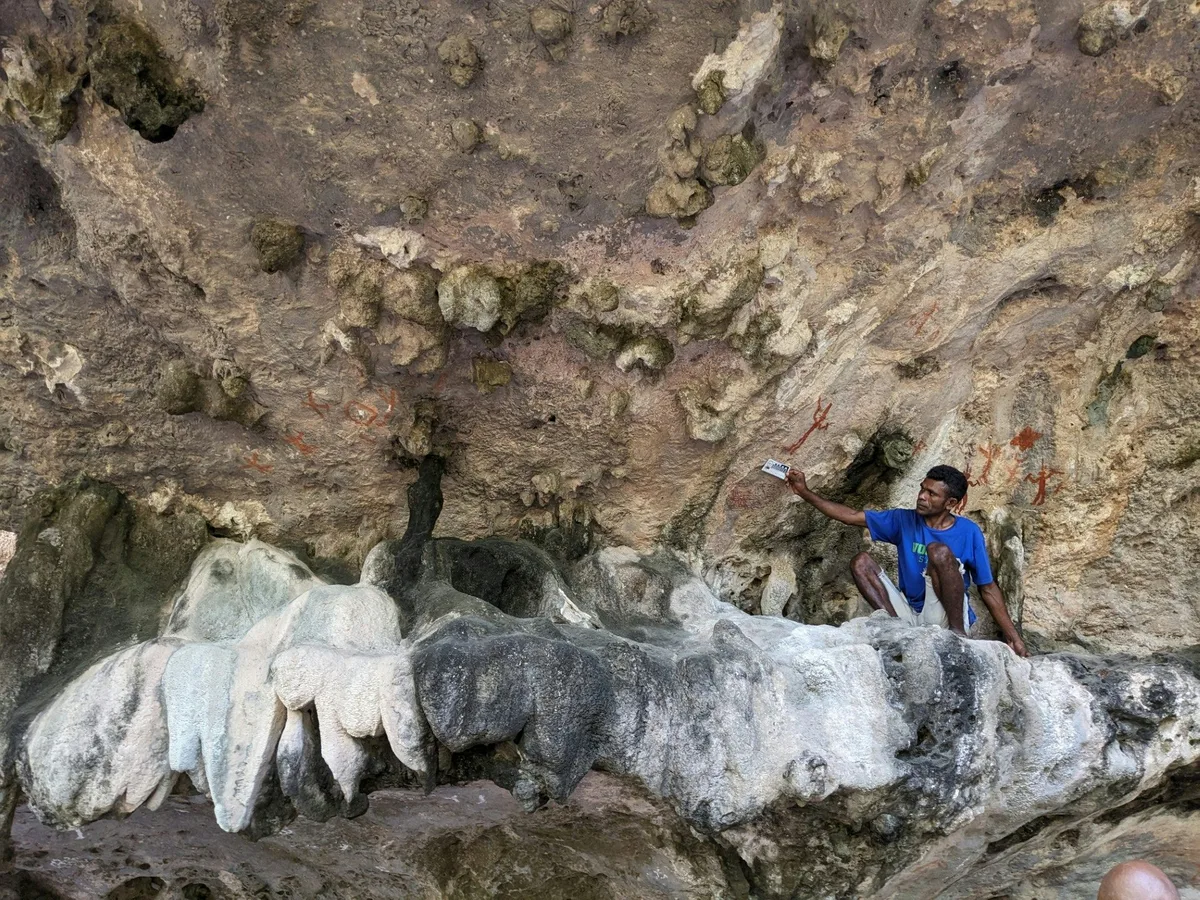
But what exactly drove these people to make these distant and dangerous voyages? Our discovery of a 4,000-year-old painting of a sunburst in southeastern Indonesia offers some clues.
This painting of a sunburst may explain why ancient people in Taiwan sailed thousands of kilometres into the unknown.
Shimona Kealy A charismatic cultural identity Austronesian is a close-knit language family spoken across much of Malaysia, the Philippines, Indonesia, Madagascar and the Pacific Islands.
Some of the major languages in this family include Malay, Javanese, Sundanese, Tagalog, Cebuano and Malagasy.
We know the Austronesian migration began at least around 4,200 years ago, as this is when characteristic Austronesian red pottery and rectangular stone adzes (axe-like tools) appear on islands south of Taiwan.
The extraordinary seafaring abilities of Austronesians were underpinned by the outrigger canoe , but it is unclear which other factors propelled their expansion.
Previous models have suggested advancements in rice farming and storage (thanks to pottery) might have fuelled population growth, prompting the Austronesian people to migrate to neighbouring islands for new farmland.
However, rice and pottery are not universal features of Austronesian societies.
An alternative theory is that there was a powerful and charismatic cultural identity shared by the Austronesian people – the kind that attracted outsiders and encouraged daring voyages to remote uninhabited islands.
Discoveries from Wetar Finding archaeological evidence for the presence of a past cultural identity is difficult, but rock art does provide a way.
In the 1992 book State of the Art , Australian anthropologist Chris Ballard observed there was a style of red rock paintings found mainly in areas where Austronesian is spoken today – eastern Indonesia, Timor and coastal New Guinea – but not in neighbouring parts of these islands where Papuan languages are spoken.
Ballard named this style of painting the Austronesian Painting Tradition (APT).
5News aggregated this summary from the outlet’s public feed. The full article, with all the context, is on theconversation.com — the content belongs to The Conversation Australia.





