Crown of Kerch: A 1,600-year-old gold, gem-studded diadem found in the grave of a Hun noblewoman
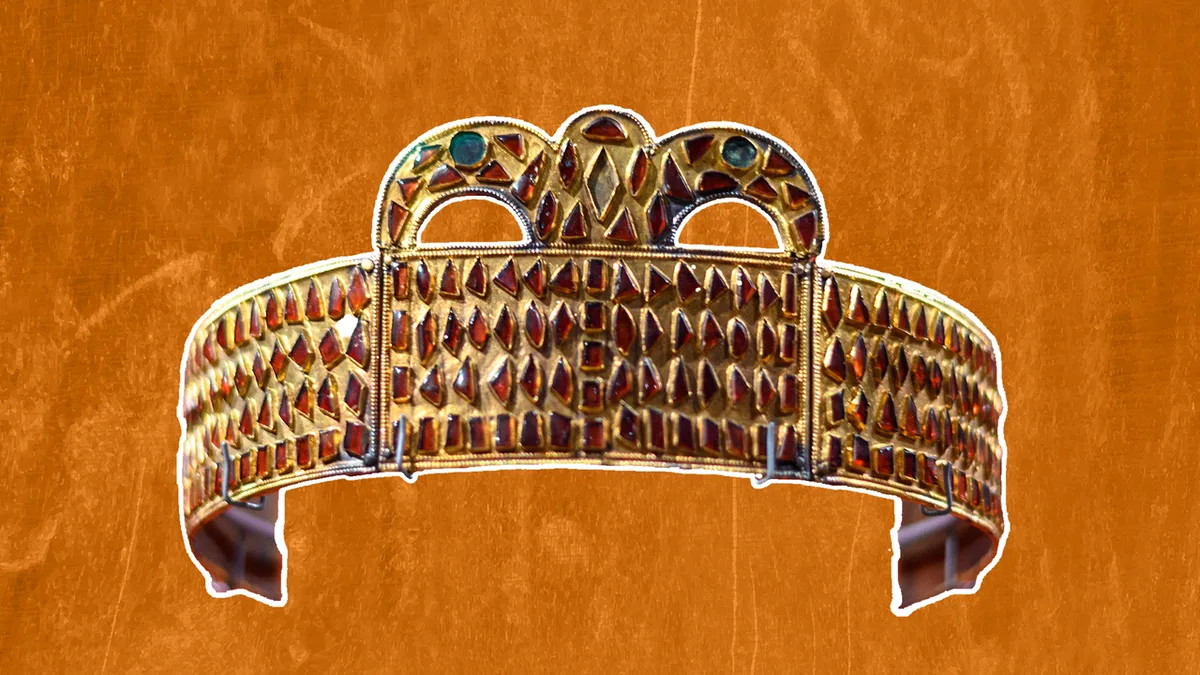
The Crown of Kerch was discovered in a high-status woman's grave in Crimea more than a century ago. (Image credit: Mirko Kuzmanovic/Alamy) QUICK FACTS Name: Crown of Kerch What it is: A gold-and-garnet diadem Where it is from: Kerch, Crimea When it was made: Late fourth to early fifth centuries At the beginning of the 20th century, a German art collector acquired dozens of artifacts from a Russian-led excavation of an ancient Hun settlement in Crimea.
The most spectacular piece of the collection was the Crown of Kerch — a garnet-studded, gold diadem featuring stylized birds of prey.
The artifact, which is now on display at the Neues Museum in Berlin, is made up of three gold-covered, bronze plaques and more than 250 gem-studded cells.
According to the museum, the crown was discovered in the grave of a high-status woman buried in the ancient city of Pantikapaion on what is now the Kerch Peninsula of Crimea.
The band of the rare gold diadem is roughly 1.7 inches (4.4 centimeters) tall and is associated with the fearsome nomadic warriors known as the Huns , who moved west from the Don River in what is now Russia in the late fourth century A.D.
Pantikapaion was founded as a Greek colony in the sixth century B.C. but was conquered by the Huns in the late fourth century A.D.
A large necropolis with as many as 2,000 burials was excavated at Pantikapaion in the early 20th century, but only a handful of artifacts and skulls were saved from the excavation.
Pantikapaion was incorporated into the Byzantine Empire in the sixth century by Emperor Justinian I.
The Crown of Kerch features two stylized heads of birds of prey, likely eagles, flanking a central floral motif.
Round, green gems mark the birds' eyes.
These birds likely represented power and authority among the Huns and other groups, according to the museum, and they were a popular symbol on jewelry and accessories of the time.
Similar birds of prey have been found on Visigoth women's jewelry in Spain from the sixth century, for example.
German archaeologist Joachim Werner wrote in a 1956 study that the Crown of Kerch was found in a burial chamber near the skeleton of a woman with an artificially modified skull .
Although the woman was buried with the diadem, Werner believed that these items were not just used for grave goods, and that high-status Hun women regularly wore the accessory during life, possibly with a cloth cap or veil attached.
5News aggregated this summary from the outlet’s public feed. The full article, with all the context, is on www.livescience.com — the content belongs to Live Science.