It's time to reassess the size of our solar system, scientists say
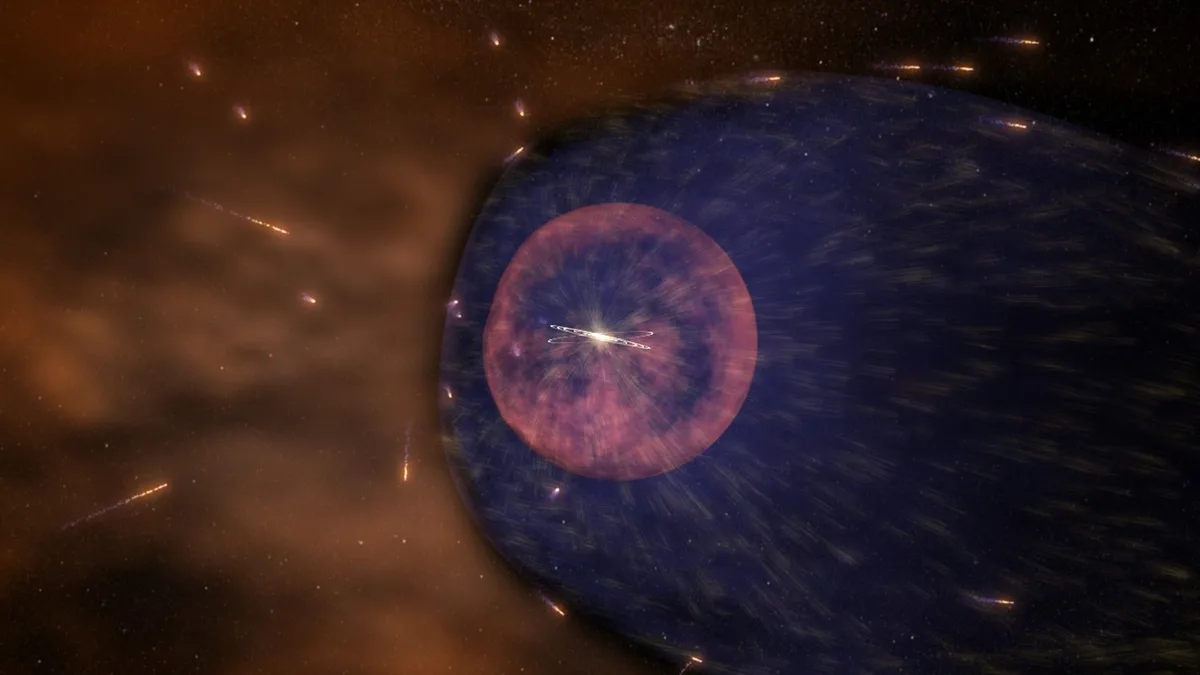
Two leading space scientists say there is a need to redefine the edge of the solar system by presenting a theory which states that measurements of the Milky Way's gravitational field, including its dark matter, redraws the sun's frontier.
That theory was put forward by Jim Green, former NASA chief scientist and past director of the space agency's Planetary Science Division, along with Ed Belbruno, a professor of mathematics at Yeshiva University and a senior research associate at Princeton University.
The solar system's gravitational frontier extends to nearly 3.8 light-years from the sun , they contend, roughly 241,000 astronomical units (AU), a distance that brings the "edge" of the solar system to within the same scale as the separation between neighboring stars.
The edge of our solar system may be defined not by a sharp boundary, but by a "complex dance among forces, energies and trajectories," they write.
Green and Belbruno recently made their case in the August 2026 issue of the magazine ROOM - the Space Journal of Asgardia.
Slow moving objects Moreover, this theory claims that the gravitationally stable Solar Lagrange points L1 and L2 could form a type of "portal" that could funnel future interstellar visitors such as the recent comet 3I/ATLAS into the solar system, perhaps allowing scientists to capture them for future study.
"Discovering the solar-galactic center L1 location is important since slow moving objects that enter this region can be captured by our sun and become part of our solar system," Green told Space.com.
"Who knows if there may be a large captured rogue planet on its way into the solar system right now," he said.
Green said there's a need to look at these newly calculated L1 and L2 locations to see what could be found.
He is now in discussion about making such observations with the New Horizons spacecraft team that explored Pluto in 2015 and is now operating in the outer heliosphere.
"Even accumulated dust in this region could verify many of the calculations we have made including the extent of the dark matter in our galaxy," said Green.
A diagram showing the Lagrange points L1 though L5. (Image credit: NASA Goddard Space Flight Center Scientific Visualization Studio) Ballistic capture "It's a really nice and significant result," Belbruno told Space.com.
The ROOM article, written for a popular audience, draws from his August 2025 keynote lecture at the Niels Bohr Institute.
Much of the theory also stems from Belbruno's work on permanent capture into the solar system and weak stability boundaries published in 2024 in the journal Celestial Mechanics and Dynamical Astronomy.
5News aggregated this summary from the outlet’s public feed. The full article, with all the context, is on www.space.com — the content belongs to Space.com.