Woodstock, Lilith Fair, and Taco Bell Rolled Into One
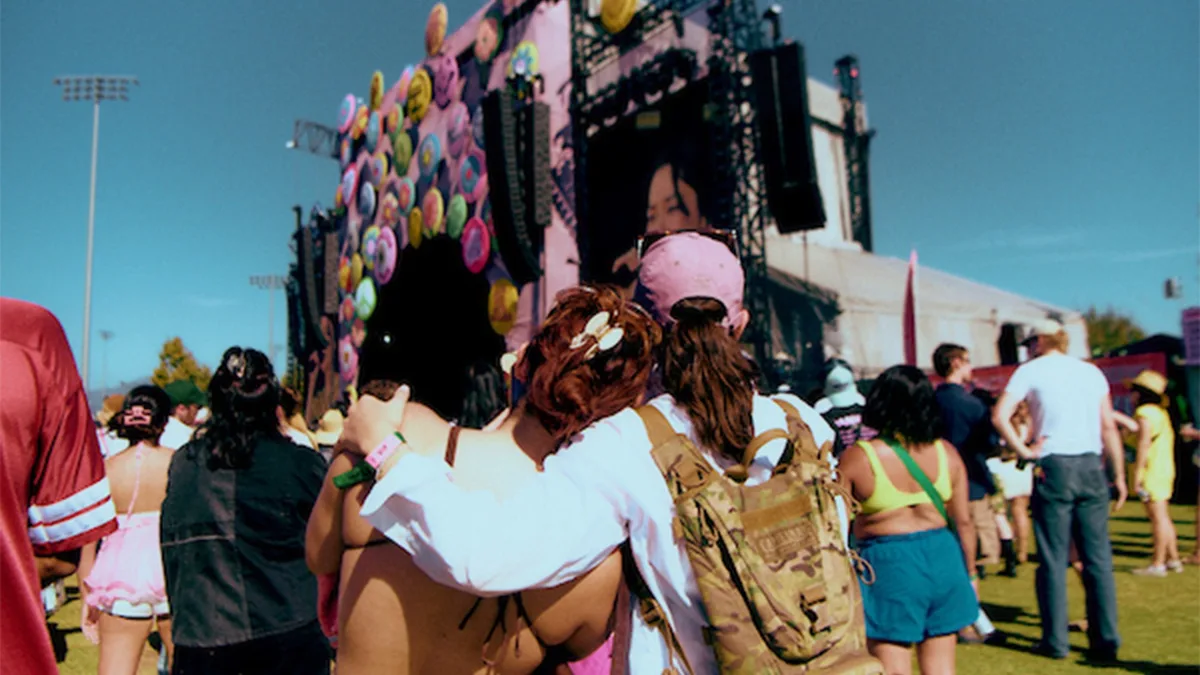
Early Saturday afternoon at the Daisy Chain Fields festival, in Irvine, California, the 25-year-old singer Eli twirled in a tank top emblazoned with a cartoon guitar while singing songs whose plasticky violins recalled the kind of music played on the Disney Channel in 2004.
Dancers waved poles with dresses attached to them as if they were flags.
She took out her phone, whose case was shaped like a cute bear, and read some thoughts she’d jotted down.
“This journal entry is to show you my fundamental belief that we must redistribute wealth,” she said.
“We must love our neighbors no matter what they believe or don’t.
We must unite with each other and radicalize.
Eat the identity politics that deceive and divide us all, as well as”—here she broke into a ragged moan—“eating the rich!” Eli is a campy artist of questionable earnestness, but her statement was in line with the mood of Daisy Chain—a place where girlish aesthetics that are so often seen as frivolous could accompany calls for revolution.
Organized by the 23-year-old pop star Olivia Rodrigo, the inaugural edition of the festival featured an all-female lineup and raised $20 million—half of which was donated by Melinda French Gates—for an array of women’s-rights organizations, including Planned Parenthood and the National Domestic Workers Alliance.
Even as a brutal heat wave threatened to smother the energy, the fest felt like a cheerful coming-out party—an announcement of the political commitments of a generation of mainstream artists more famous for singing about the self than about society.
Rodrigo patterned Daisy Chain off of Lilith Fair, the best-selling female-fronted touring festival that ran from 1997 to 1999, but the two events are a study in contrasts.
Lilith’s co-founder Sarah McLachlan wanted to prove the viability of female musicians at a time when, she told the LA Times , radio programmers were reluctant to play two of them back-to-back.
The lineup reflected a boom in singer-songwriters—Tracy Chapman, Jewel, Paula Cole, Indigo Girls—whose socially conscientious songs harkened back to the spirit of Woodstock (an obvious influence on the flower-powery Daisy Chain as well).
Lilith’s aesthetics were earthen and earnest—a celebration of an ideal of strong, serious womanhood, much to the perturbation of late-night comics who cracked jokes about Cole’s armpit hair.
Today, women aren’t so marginal to the record industry; in fact, it can sometimes seem like Taylor Swift and her disciples are the record industry.
5News aggregated this summary from the outlet’s public feed. The full article, with all the context, is on www.theatlantic.com — the content belongs to The Atlantic.