OpenAI lifts the lid on its in-house Jalapeño chip - with benchmarks claiming it beats Nvidia's GB300
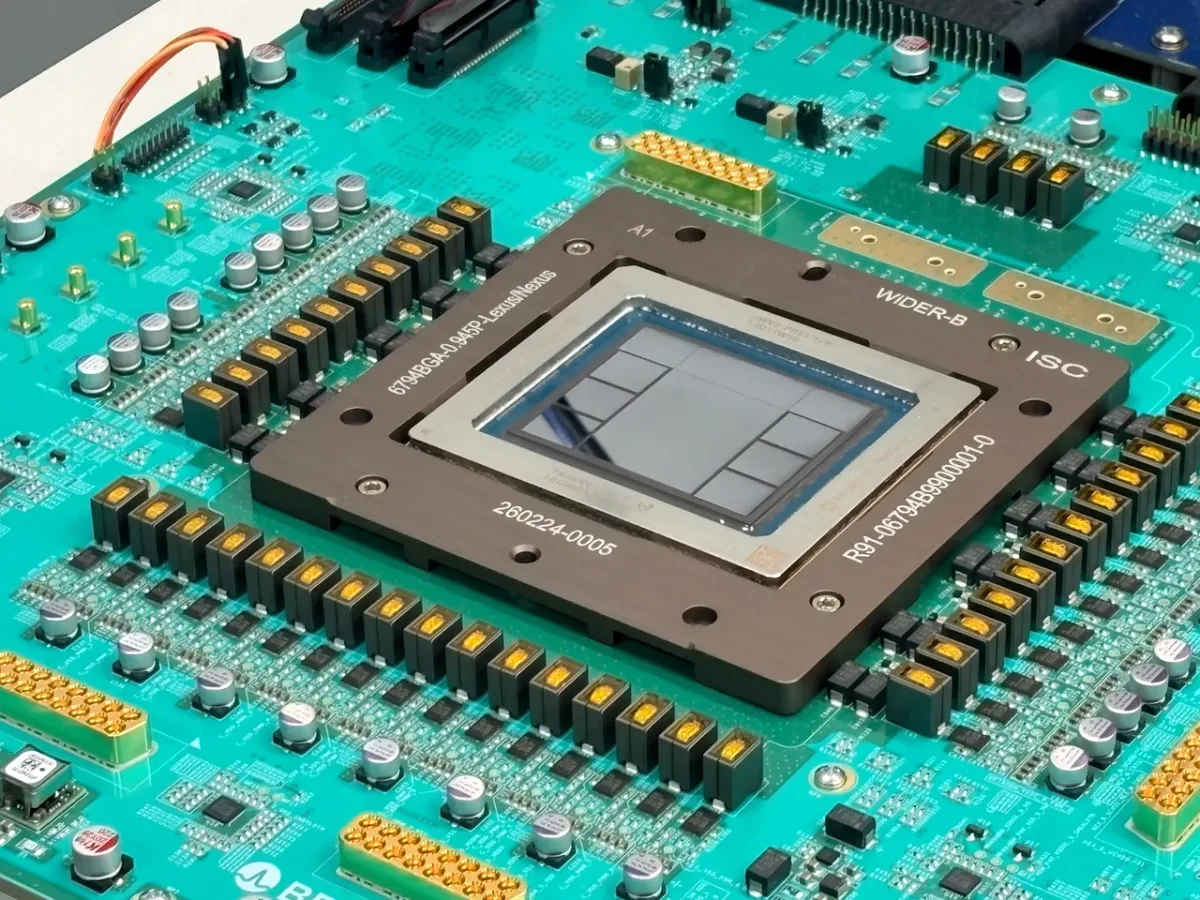
OpenAI published the first Jalapeño benchmarks at Hot Chips, claiming 1.5 to 1.9x more throughput per kilowatt and up to 3.6x lower latency than Nvidia's GB200 and GB300 rack systems The chip's purported gains are at a reported 700W power draw and center around efficiency, with Nvidia's GB300 still leading on absolute throughput per package by 20-25 percent.
The numbers are currently self-reported, and volume production of the chip is not expected to ramp up until 2027 OpenAI took the stage at Hot Chips on August 25 with the first published performance figures for Jalapeño, the inference accelerator it co-developed with Broadcom, and the numbers are designed to be read the way it flatters the former: efficiency.
The company reported 1.5 to 1.9 times more throughput per kilowatt and 1.7 to 3.6 times lower end-to-end latency across three open models than the Nvidia rack systems it tested against.
OpenAI's Jalapeño is currently rated at 700W, versus comparable Nvidia silicon that was rated for 1200W and 1400W, a key differentiator in a benchmark that already has limited information available to researchers looking to pick a clear winner.
AI efficiency takes center stage? OpenAI's Jalapeño is an ASIC, or an Application-specific integrated circuit, which essentially means that it focuses primarily on and is great for very specific AI workloads; in this case, OpenAI's inference needs, which allow it to run multiple models with significant efficiency gains in tow.
Richard Ho, who runs OpenAI's hardware program, told reporters on a press call that the results show "a very, very significant performance advance over state-of-the-art." OpenAI ran SemiAnalysis's public InferenceX suite on GPT-OSS 120B, DeepSeek R1 670B, and Moonshot AI's trillion-parameter Kimi K2.5, at a nominal 8,000-token input and 1,000-token output.
It scored a 1.9x efficiency win vs.
GB200 on its own GPT-OSS model, and 1.7x and 1.5x on DeepSeek and Moonshot's offerings against a GB300 system.
Interestingly, the figures for GPT-OSS 120B running on a GB300 compared to OpenAI's Jalapeño are not published.
It is important to point out here that there is a certain degree of cherry-picking to flatter OpenAI's own results: by choosing to compare ratios on a per-kilowatt basis versus a per-chip basis, while efficiency remains consistent, it does paint Jalapeño as potentially a much more potent competitor to Nvidia's last-generation offerings than it actually is.
Nvidia's GB300 might not have an efficiency win versus Jalapeño, but it remains a much more powerful chip in all tests, at a time when Nvidia is already rolling out Vera Rubin .
5News aggregated this summary from the outlet’s public feed. The full article, with all the context, is on www.techradar.com — the content belongs to TechRadar.