From celluloid to digital: the changing face of Chennai’s cinema industry
Account subscription benefits alongside Premium Stories, Editorials, Opinions and more. Unlock these with Subscription
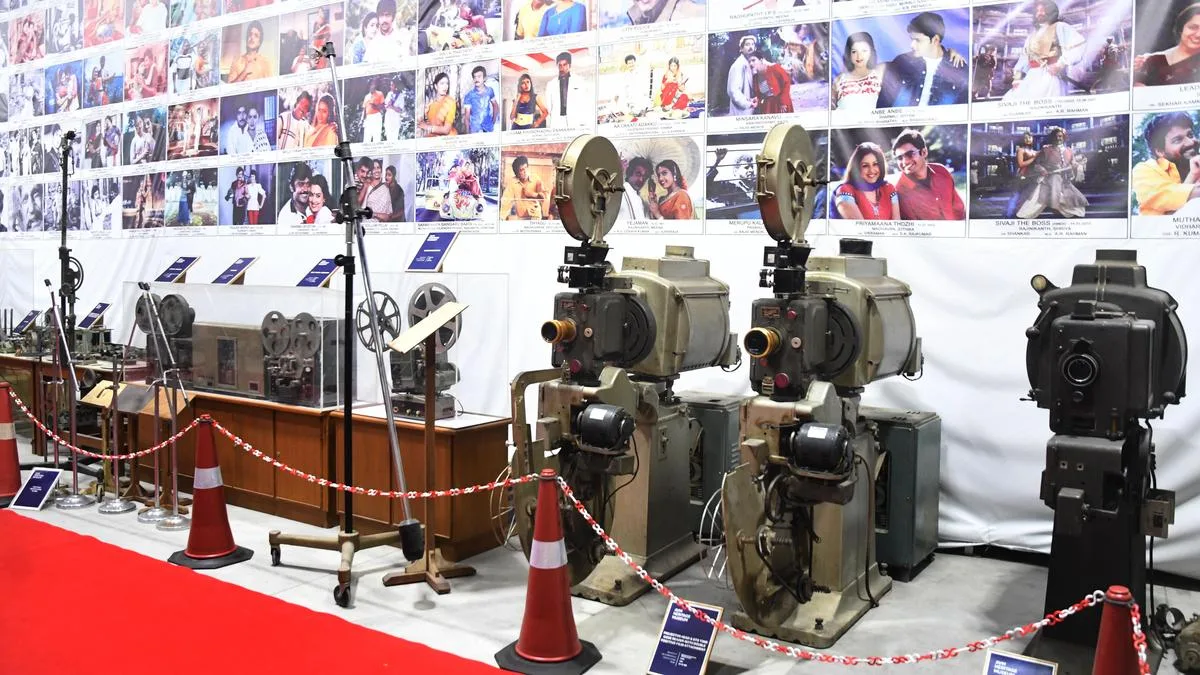
Film equipment preserved at the AVM Heritage Museum. | Photo Credit: JOTHI RAMALINGAM B
Nothing gives a better idea of what Madras was like 80 years ago than scenes from the film En Manaivi, released in 1942. Indian medicine specialist Vembu Iyer, played by the late T.R. Sarangapani, tells his friend and patient that he moved from Pattanam (Mylapore) to the village of Kodambakkam to prevent his wife from visiting her relatives regularly.
The film begins with the arrival of a train at Kodambakkam railway station, surrounded by trees, waterbodies, and houses set amid paddy fields. In 84 years, Kodambakkam — or Kollywood, the heart of Tamil cinema — has changed beyond recognition. So has the Tamil film world.
The film was produced by A.V. Meiyappan, who established the AVM studio in Vadapalani on 10 acres of land that once housed a tannery. He bought the land for ₹37,500, a princely sum in those days.
He constantly experimented with filmmaking and was among the first to achieve post-synchronisation when the required technology was not available. In the film Sri Valli , when the heroine, Kumari Rukmini, could not match the pitch of the hero, T.R. Mahalingam, Meiyappan recorded the songs in the voice of playback singer Periyanayaki.
In his memoir, Enadhu Vaazhkai Anubhavangal, he writes that his experiment was a phenomenal success, and that the film — produced on a budget of ₹2 lakh in 1945 — earned a tenfold profit. He introduced the latest technology and imported the U.S.-made Mitchell 35 mm camera, which is preserved at the AVM Heritage Museum, offering a glimpse into the sweeping changes embraced by the film world.
Who would have thought that cinemas that once ran with a single projector — with four breaks as there was no second projector to keep the entire film ready for screening — would adapt to IMAX, even though they have fallen on hard times with the advent of exclusive film channels and OTT platforms?
Even filmmaking has undergone great changes — from shooting thousands of feet of film to embracing digital technology. Writer Ashokamitran, in My Years with Boss at Gemini Studios , recalls how thousands of feet of film shot for Avvaiyar were trimmed to create the final product. “Vasan (the boss) sat down to select from the miles of footage — only in films can the footage be in miles. He sat for hours viewing the projection of all that had already been shot, while his editors stood by with scissors and splicers. Every time he closed his eyes, a thousand feet were cut. He streamlined the multi-styled rendering, freshly shot, and inserted connecting links from scene to scene, gave a truly poetic beginning to the film, and ended it with a spectacular ‘ascent to the heavens’ finale,” he writes.
But Meiyappan dispensed with the practice of shooting 20,000 feet of film and inserting over 50 songs, and began making shorter films. When he released Naam Iruvar, S.S. Vasan congratulated him on making a good film in a small town without sophisticated equipment.
Cinematographer-turned-actor M.
5News aggregated this summary from the outlet’s public feed. The full article, with all the context, is on www.thehindu.com — the content belongs to The Hindu - National.