The Bhotekoshi flood | A Himalayan tragedy
Account subscription benefits alongside Premium Stories, Editorials, Opinions and more. Unlock these with Subscription
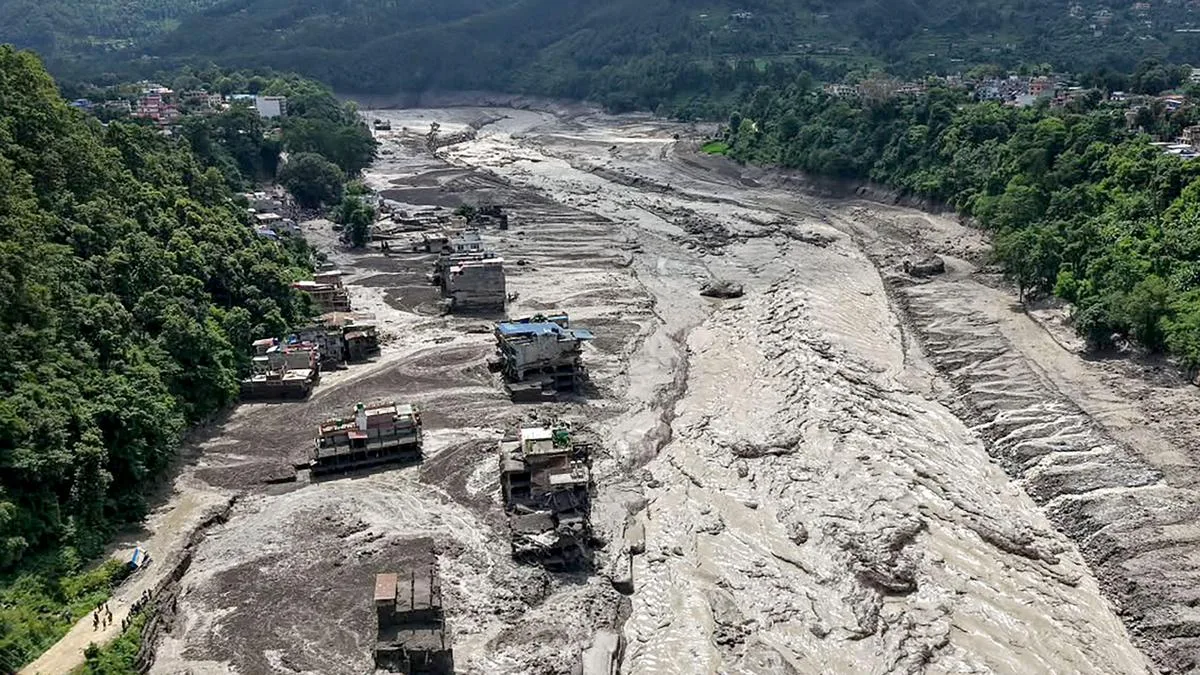
Houses lie partially submerged in muddy water along a riverside after flash floods at Trishuli Bazaar in Nepal's Nuwakot district on August 26, 2026. | Photo Credit: AFP
Ramesh Kumar, a journalist based in Kathmandu, on Thursday (August 27, 2026) posted a photograph of a clock tower, its hands stopped at 09.29.
“A clock that would never show the time again,” he wrote on X, formerly Twitter. “Betrawati.”
Mr. Kumar had reached Betrawati in Nuwakot district, a town devastated by the previous day’s flood in the Bhotekoshi River in neighbouring Rasuwa district, which borders Tibet. After touring Betrawati, where he was born and raised, he made a grim assessment: “Will Betrawati ever revive as a bazaar again? Almost impossible.”
The extraordinary velocity and scale of the flash flood in the Bhotekoshi River at around 8.40 a.m. on Wednesday (August 26, 2026) have left more than 600 dead and close to 2,500 missing, including foreign nationals, mostly from India.
The Nepal government promptly got into action, mobilising personnel from the Nepal Army, Nepal Police and the Armed Police Force, as it mounted a massive search-and-rescue operation.
Scientists, meanwhile, struggled to piece together the chain of events and determine the origin of the flood, as they wondered about the enormity of the disaster, with some describing it as the worst since the 2015 earthquake.
Regarding the origin, the Nepalese and Chinese sides have concluded that the source was in the Langtang Lirung area. Identifying the exact point where the initial collapse occurred and which side of the border it was on may be difficult.
According to an official at Nepal’s Department of Hydrology and Meteorology, satellite imagery shared by the Chinese side pointed to a combination of an ice avalanche, permafrost movement and a rockslide along the Nepal-China border, with the rockslide occurring on the Chinese side and its impact extending into Nepal.
“The avalanche originated on the Nepalese side of the territory, but very close to the boundary, and induced flooding that crossed the Nepal-China border, causing extensive damage on both sides,” said Binod Parajuli, a senior divisional hydrologist at the department’s flood forecasting division.
The location scientists are pointing to is in the Lhende Khola, a transboundary high-altitude river that originates in Gyirong County in Tibet and flows south into Nepal, where it is a tributary of the Bhotekoshi and Trishuli river systems.
Flooding in the Bhotekoshi River is not uncommon. Last year, in July, a flood — caused without rainfall — in the Bhotekoshi wreaked damage and destruction. Scientists later concluded that the disaster was associated with a glacial lake outburst flood (GLOF).
While scientists initially considered whether this year’s flood could also have been linked to a GLOF, its velocity and ferocity, which washed away villages downstream in three districts — Rasuwa, Nuwakot and Dhading — prompted experts to examine it from a different angle.
5News aggregated this summary from the outlet’s public feed. The full article, with all the context, is on www.thehindu.com — the content belongs to The Hindu.