This Jurassic bird skipped flight school
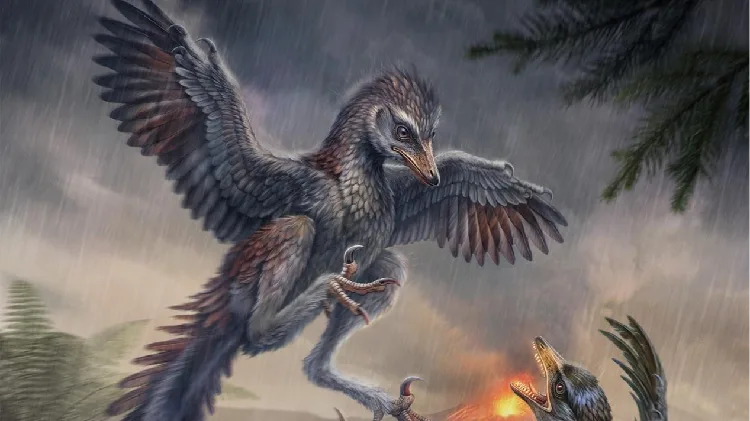
A newly discovered Jurassic bird from southeastern China is challenging the long-held view that early bird evolution was driven mainly by the need to fly.
Named Yuezhuornis yangyuanensis, the species was identified by researchers from the Institute of Vertebrate Paleontology and Paleoanthropology of the Chinese Academy of Sciences and the Fujian Institute of Geological Sciences.
The findings were published in the journal Nature on October 14.
The fossil was discovered in August 2024 in Yangyuan Township, Zhenghe County, southeast China's Fujian Province.
Weighing about 821 grams, the animal had a striking mix of bird-like and dinosaur-like features.
Most notably, its forelimbs were unusually short, while its feet retained a specialized second toe characteristic of Deinonychosauria dinosaurs.
Comprehensive skeletal and phylogenetic analyses confirmed that the animal was a bird, not a non-avian dinosaur.
Further analyses suggest it was a carnivore adapted to terrestrial life and incapable of flight.
For decades, scientists have regarded selection for flight as a major driver of early bird evolution.
However, the scarcity of Jurassic bird fossils has left significant gaps in understanding how the characteristic bird body plan emerged.
Yuezhuornis yangyuanensis provides evidence that early birds did not all follow one single evolutionary path toward better flight.
Instead, they explored different ecological niches, including terrestrial lifestyles that did not require flight.
The discovery adds to the growing fossil record of the Zhenghe Fauna, which includes other early birds and dinosaurs with different adaptations.
Together, these finds reveal a richer picture of ecological diversity during the early evolution of birds.
此摘要由5News从媒体的公开信息源汇聚而成。 包含完整背景的全文在www.cgtn.com — 内容归CGTN Tech & Sci (oficial)所有。