Chinese scientists develop nuclear optical clock
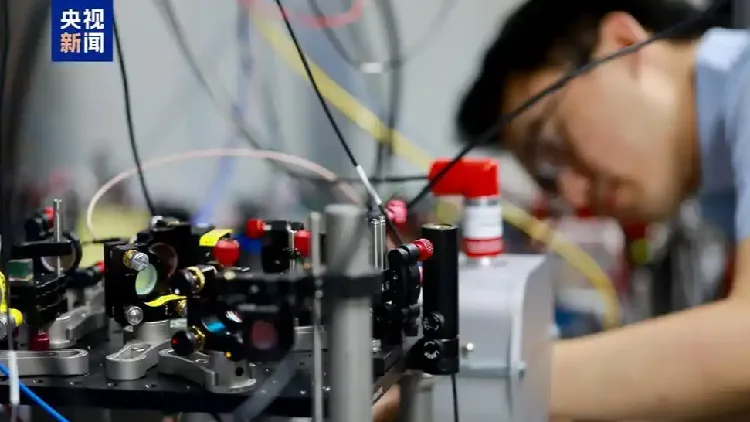
Chinese scientists have developed a nuclear optical clock that uses the nucleus of a thorium-229 atom to keep time, marking a major advance toward a new generation of highly precise clocks.
A team led by Ding Shiqian at Tsinghua University used a specially developed continuous-wave ultraviolet laser and a tiny crystal containing thorium-229 to detect and precisely measure a transition inside the atomic nucleus.
The team then locked the laser's frequency to this nuclear transition, allowing the system to operate as a nuclear optical clock.
The findings were published online in Nature on Wednesday.
The Chinese team and a European team achieved nuclear optical clock operation independently at around the same time.
Today's most precise optical clocks use transitions involving electrons in atoms.
A nuclear optical clock instead uses a transition inside the atomic nucleus as its timing reference.
Because the nucleus is much smaller than the surrounding atom, it is less susceptible to disturbances from the external environment, potentially allowing even more precise timekeeping.
The technology could also offer advantages in size and engineering, with potential applications in satellite navigation and deep-space exploration, where highly accurate timing is essential.
A major obstacle has been the need for a continuous-wave laser with a wavelength of 148 nanometers, needed to precisely drive the thorium-229 transition.
Ding's team was the first to develop such a laser.
The team also overcame a shortage of thorium-229.
Using just 1.4 micrograms of the isotope, researchers successfully produced a millimeter-scale thorium-doped calcium fluoride crystal in a single attempt.
The amount used was about 200 times less than that used by the European team.
此摘要由5News从媒体的公开信息源汇聚而成。 包含完整背景的全文在www.cgtn.com — 内容归CGTN World (oficial)所有。