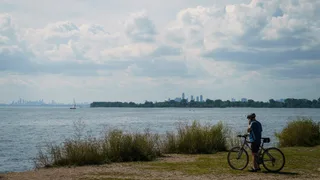
Trump’s ‘renaming’ of Lake Ontario is emblematic of centuries of colonial erasure

The ongoing economic spat between Canada and the United States took a strange turn after U.S.
President Donald Trump signed an executive order “renaming” Lake Ontario as Lake America .
The lake is the second body of water to be renamed by Trump.
In January 2025, he similarly ordered that the Gulf of Mexico be renamed the Gulf of America .
That same order also officially changed Alaska’s Mount Denali to its colonial name, Mount McKinley.
While many might view Trump’s renamings as comical or unserious, for Indigenous communities, they are reminiscent of centuries of settler-colonial erasure.
What’s in a place name? The name Ontario can be traced to the Huron word ontarí:io, a Wyandot (Huron) word meaning “the lake is great/large,” with a root ontar- meaning “lake” and a suffix -io meaning “great/large.” Observant readers might notice that Ohio has the same -io suffix, translating to “large creek.” The first written mention of the name Ontario was in 1641 .
Of course, the name predates 1641 and has existed for centuries.
It is an example of an Indigenous place name that was adopted by European settlers.
This, however, is not how all place names were adopted in Canada.
Long before European explorers arrived in North America, Indigenous people already had their own ways of naming geographic locations, which were passed down orally by elders .
Naming tends to be descriptive, like we find in places in Nunavut such as Aulattivik (peninsulas where animals were hunted) or Qikiqtarjuaq (big island).
Europeans also used descriptive language to name some places, think Red River or Great Lakes.
Other times, they adapted local Indigenous words, such as Ontario, Saskatoon or Mississauga.
5News aggregated this summary from the outlet’s public feed. The full article, with all the context, is on theconversation.com — the content belongs to The Conversation Canada.