China is launching a Moon mission to find water ice. It’s unlike anything NASA has done
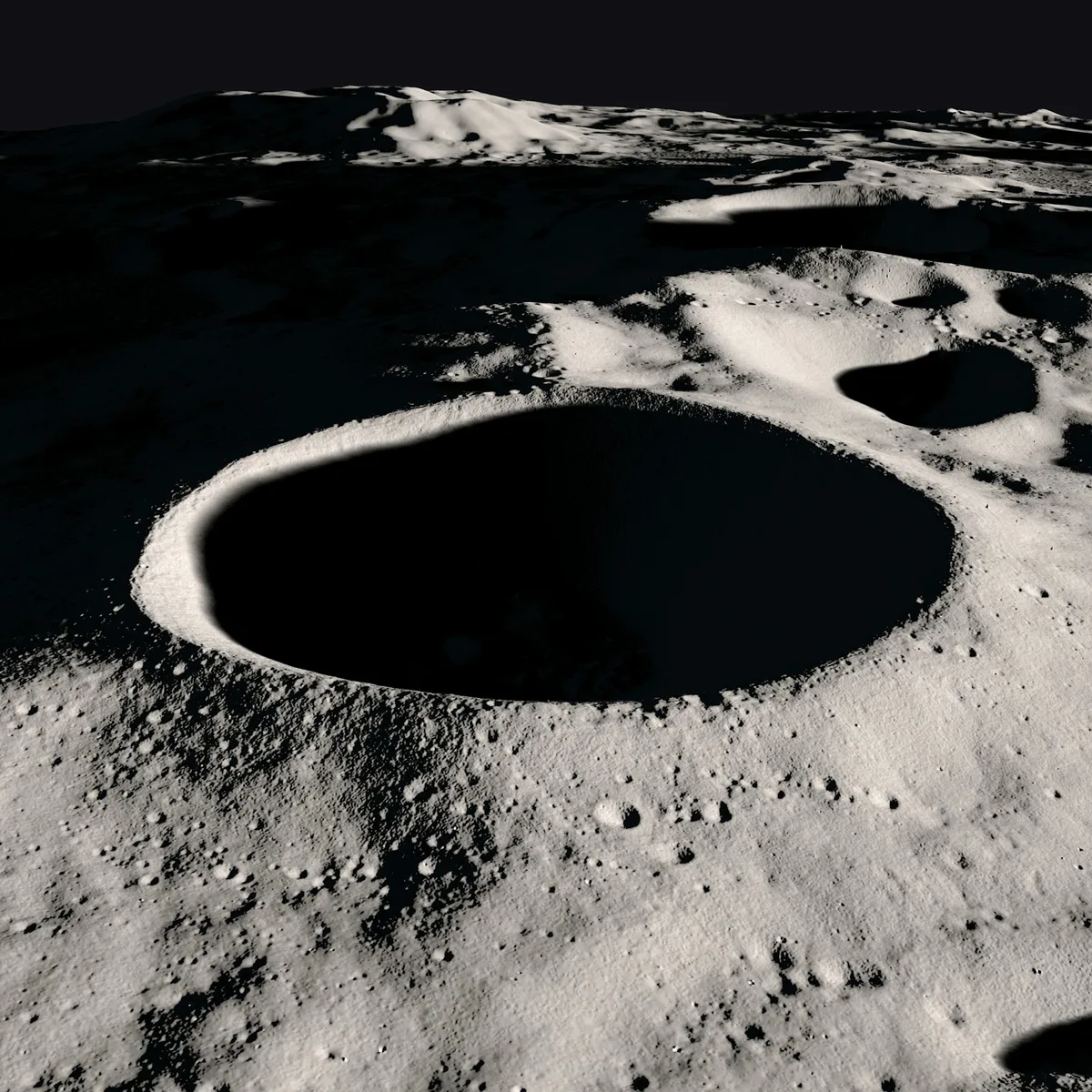
Shackleton crater on the Lunar South Pole.
NASA's Scientific Visualization Studio How do you explore a place where the Sun never shines? China’s space programme will soon embark on one of the most innovative lunar exploration missions in recent years.
We’ve known for nearly two decades that some form of water exists on the Moon .
What we still don’t know is exactly how much accessible water ice lies inside permanently shadowed craters, how deeply it is buried or what form it takes.
What we do know is that accessing that water ice will be a real challenge: it is found at the bottom of deep, hard-to-traverse craters where the Sun never shines , remaining untouched for billions of years at temperatures well below –200°C .
These are among the most valuable places on the Moon, but the hardest to reach and explore.
Lunar exploration has come a long way since the Soviet Union’s Luna-1 probe reached the Moon’s vicinity in January 1959.
The Apollo missions and their successors showed the challenge is no longer simply to reach the Moon.
It is to explore places human and conventional rovers cannot easily go, and ultimately determine whether the Moon itself can provide some of the resources that future explorers will need.
China has spent two decades building an increasingly ambitious lunar exploration programme , named after Chang'e , the ancient Chinese goddess of the Moon.
The Chang'e-7 mission is expected to set course for our celestial neighbour later this month , although a recent failure involving a different Chinese rocket has introduced some uncertainty over the launch date.
Here’s what makes this latest mission so interesting.
What is Chang'e-7 set to achieve? The mission will test several novel approaches to lunar exploration.
It will consist of an orbiter, a lander, a rover and a hopper.
5News aggregated this summary from the outlet’s public feed. The full article, with all the context, is on theconversation.com — the content belongs to The Conversation Australia.





