Two decades of tracking data unlocks new secrets to saving black rhinos
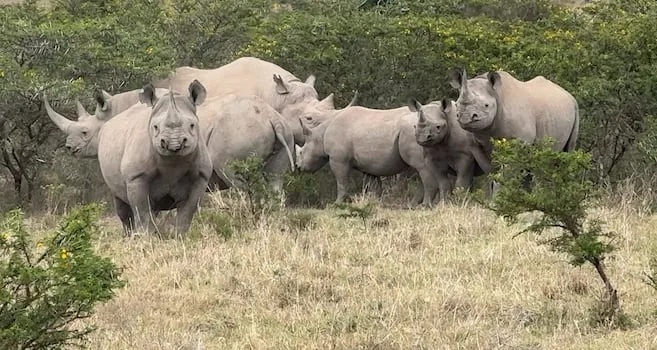
More than two decades of monitoring black rhinos as part of World Wide Fund for Nature’s (WWF’s) Black Rhino Range Expansion Project (BRREP) are providing scientists with valuable new insights into the behaviour, survival and conservation of one of Africa’s most threatened species.
BRREP started as a pilot project to bolster numbers of black rhinos in 2003. Now, more than 20 years of rhino monitoring data, collected primarily for management purposes, is turning into a treasure trove of data for scientists.
With each one of the 420 rhinos on project sites closely monitored, behavioural scientists have started digging into the data and are coming up with interesting findings.
Using the tracking information for the rhinos, one study sheds light on behavioural changes in black rhino mothers around when and where they give birth, thus helping to pinpoint birth dates and birth site selection more accurately.
In another study, scientists analysed the social interactions between the normally solitary black rhinos and the impact this might have on their survival rates.
“After more than 20 years of successfully establishing and managing black rhino populations, it is fantastic to see the information gathered on our BRREP sites being translated into scientific research that will further enhance our conservation and management efforts,” said Ursina Rusch, population manager for BRREP.
Rusch said in the past, population management often relied on anecdotal evidence for decision-making.
She said with applied scientific research, researchers can use their vast data set to make pragmatic, science-backed decisions to ensure black rhino populations remain healthy and continue to grow in numbers.
In their paper on rhino births, Devon Kerr, Rachel Stein and Adrian Shrader from the University of Pretoria’s department of zoology and entomology, devised a method for remotely identifying black rhino births.
Kerr said black rhinos were solitary, potentially dangerous and secretive, making direct observation of their births difficult. Yet, accurate information about when rhinos give birth will enhance conservation efforts.
Until now, rhino population managers have relied on rare sightings of young calves and estimates have often been off by months.
Using movement-based GPS data from BRREP sites, the black rhino study found that female rhinos showed distinct movement patterns before and after giving birth, allowing population managers to more accurately pinpoint the time of a birth.
Based on these birth date estimations, scientists were then able to better understand birth site selection of black rhino mothers in terms of habitat type and predator densities.
In another paper, Stein and Shrader used sightings and demographic data collected over a 20-year period in 14 reserves to monitor social patterns. This amounted to close to 70,000 sightings of 542 black rhinos that were categorised into calves, sub-adults and adults.
5News aggregated this summary from the outlet’s public feed. The full article, with all the context, is on www.timeslive.co.za — the content belongs to TimesLIVE.