Porsche Mission S previews a new supercar above the 911
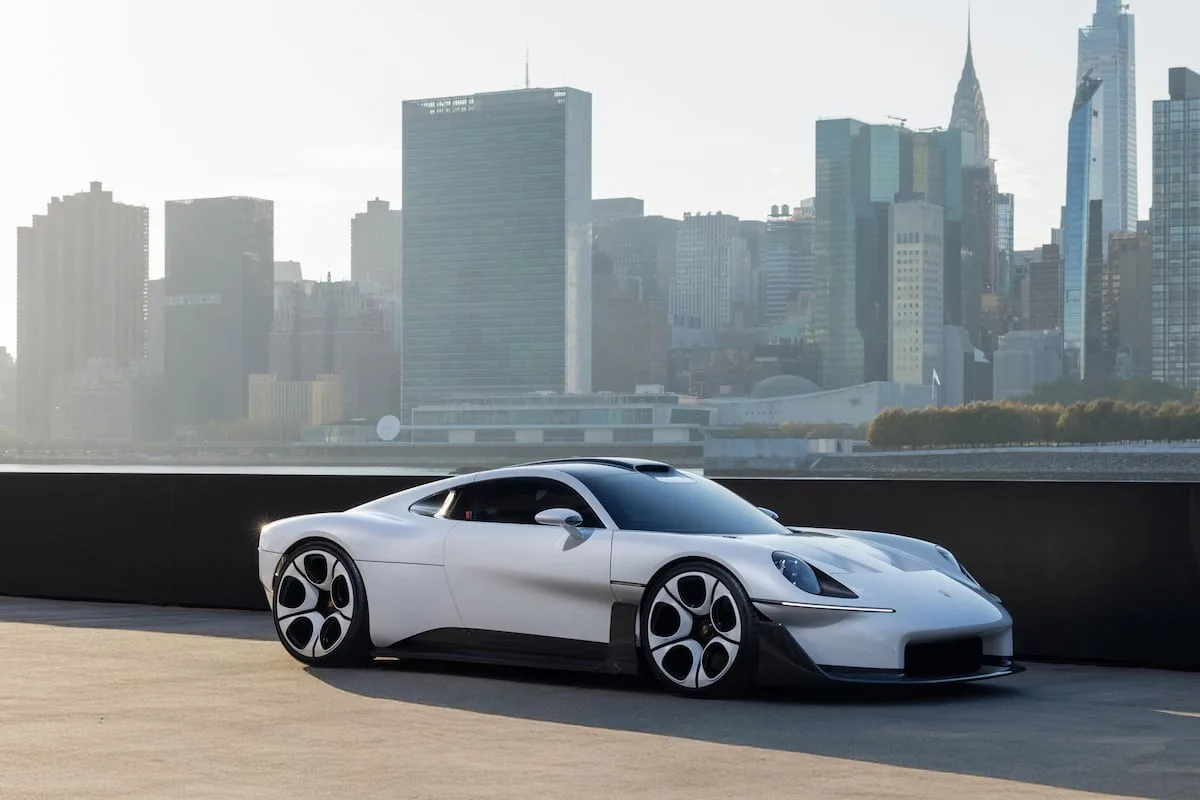
Porsche has unveiled the Mission S, a concept car that previews a new mid-engined supercar positioned above the iconic 911.
The last mid-engined Porsche supercar was the 918 Spyder which ended production in 2015.
Revealed in New York on October 15, the Mission S draws inspiration from historic Porsche models while exploring a more driver-focused approach to interior design and technology.
The unveiling took place at a pier in Queen where photographs of the mid-engined Porsche 550 Spyder were taken in 1953. Porsche regards the 550 Spyder, famously owned by James Dean, as a defining model in its history.
The Mission S forms part of the company’s Sportwagenschmiede ’35 strategic realignment, which establishes an updated design direction based on three principles: authenticity, consistency and timelessness.
Porsche chair Michael Leiters said the concept previews a new mid-engined supercar platform that will become a permanent and versatile addition to the company’s model range, rather than a limited-production hypercar.
“A Porsche must be recognisable as a Porsche at first glance. The Mission S provides a glimpse of the ideas and design features that will shape Porsche in the coming years,” he said.
The Mission S combines a low front end, prominent front fenders and a distinctive roofline with styling cues from several historic models, including the 911, 959 and GT1.
The round headlights and the striking fenders — which not only echo the familiar “torpedo”’ design but also make the side profile more present — are reminiscent of the 911.
Its mid-engined layout allows for traditional Porsche proportions, while functional elements include an active rear wing and cooling details inspired by the legendary 917 racing car of the 1970s. The lightweight wheel design references the distinctive dial-style wheels of the 928.
Inside, Porsche has prioritised driver engagement, combining analogue controls with digital displays. Five circular instruments sit behind the steering wheel, with an analogue rev counter at the centre. Their arrangement can change according to the selected driving mode.
The cabin deliberately avoids the proliferation of screens found in many modern vehicles. There is no permanently integrated central touchscreen or fixed passenger display. Instead, a retractable smartphone holder compatible with Apple’s MagSafe system allows the driver’s phone to serve as a navigation or information display when required.
Physical buttons, switches and new push-pull controls provide direct access to driving and comfort functions, while a redesigned Sport Chrono element blends traditional styling with digital technology.
Two defining lines run through the dashboard and doors. They convey the characteristic feeling of sitting deep within the car and create a visual link to the exterior design
5News aggregated this summary from the outlet’s public feed. The full article, with all the context, is on www.businesslive.co.za — the content belongs to Business Day.