Nepal-Tibet floods: Death toll hits 362 as more than 1,400 remain missing
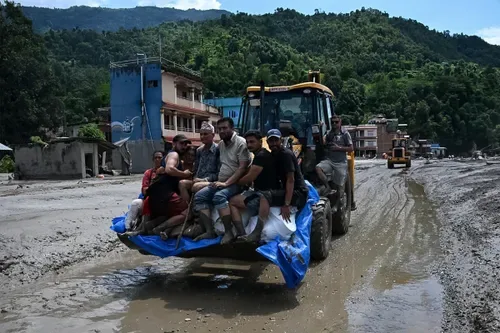
Rescue personnel transport stranded residents using a bulldozer after flash floods in the Devighat area in Nepal's Nuwakot district on August 27, 2026.
Rescue teams waded through mud on Thursday, searching for more than 1,400 people missing after flash floods and landslides struck the Nepal-Tibet border, as the death toll rose sharpl y to at least 362, with entire villages swept away.
Experts warned of the risk of further floods a day after the devastating tsunami-like wall of freezing water and mud wiped out towns under a torrent of sludge, engulfing homes, smashing bridges and dams, and sweeping vehicles away like toys.
Many of the missing are foreign tourists, including scores of Hindu pilgrims to Tibet's sacred snow-capped Mount Kailash.
According to the US Geological Survey (USGS), the disaster was caused by a glacial collapse that triggered a vast flow of icy debris.
Emergency teams were racing to pluck survivors from affected zones, while Nepali soldiers used sniffer dogs to search for bodies buried under the suffocating dirt.
"Everything is finished," Omkar Joshi, a 35-year-old Nepali customs agent rescued from a hilltop in the border town of Timure, told AFP.
"It is a giant graveyard. All that is left are sand and pebbles, soaked red by human blood."
Another 910 people, including 517 foreign tourists, were out of contact in the country. Beijing said 100 Chinese citizens are missing in Nepal.
In China, state media said the "mudslide disaster" at the Gyirong Port in Tibet killed three people, while 558 people, including 260 foreigners, are missing.
Chinese Premier Li Qiang visited the area on Thursday, state media said, to oversee "emergency rescue and relief work, and to visit rescue workers and affected people".
Li Qipu, a member of China's paramilitary People's Armed Police, cited "the instability of a reservoir lake upstream" and "the narrow mountain road" as elements complicating rescue efforts.
China's Tibet Autonomous Region is largely inaccessible to foreign journalists.
Prime Minister Balendra Shah, who urged the Himalayan nation to "stand together" hours after the disaster, visited some of the hardest-hit areas on Thursday.
5News aggregated this summary from the outlet’s public feed. The full article, with all the context, is on iol.co.za — the content belongs to IOL.