Uber beats Waymo as first to launch robotaxis in London
The cars have no lidar and no geofence, but still will have human safety drivers for the initial launch.
The cars have no lidar and no geofence, but still will have human safety drivers for the initial launch.
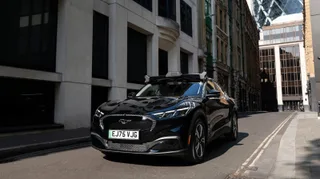
Uber beat out Waymo in launching a commercial robotaxi service in London, the city’s first. The vehicles use autonomous driving tech developed by Wayve , a UK-based startup, and will initially feature safety drivers behind the wheel.
The launch is a milestone for Uber, which has been plotting a UK launch with Wayve for several years . In beating Waymo to the punch, it allows Uber to set the standard for the robotaxi experience for thousands of Londoners. It’s also an early test of whether there’s appetite for driverless ridehailing beyond the US and China, where most of the world’s robotaxis are currently clustered. (There’s a smattering in the Middle East, too.)
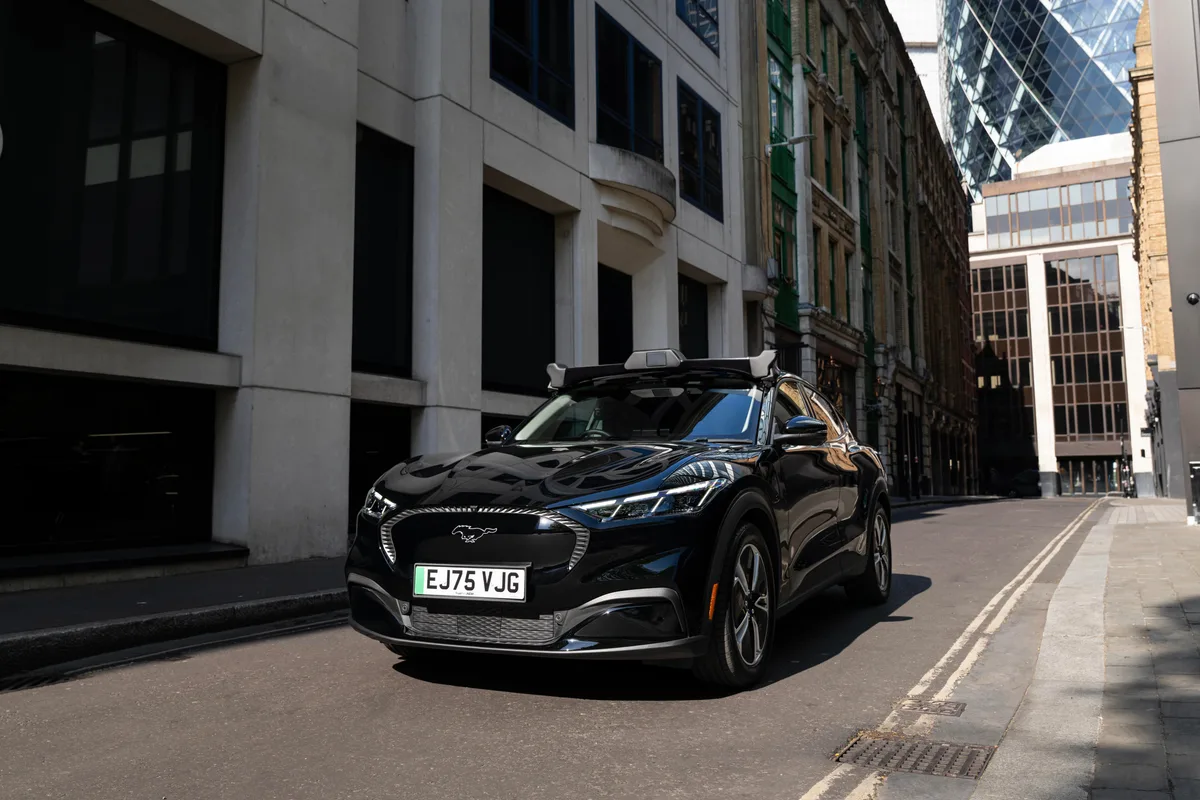
London-based Uber customers who want to try out these new robot-controlled cars can indicate their preference in the app’s settings. When booking a ride through UberX, Uber Comfort, or Uber Electric, riders may be paired with a Wayve-developed autonomous vehicle, but it’s not a guarantee. Wayve is using Ford Mustang Mach-Es for its fleet, followed by the Nissan Leaf in the future.
Safety drivers will monitor the driving from the front seat, though Uber says they won’t control the driving and will gradually be phased out in favor of fully driverless vehicles. Safety drivers are licensed by Transport for London, the city’s transit authority.
Uber says there will be no geofence — the virtual boundary within which robotaxis are programed to operate — because Wayve’s AV2.0 system is designed to move “beyond the constraints of traditional AV systems.” Wayve describes AV2.0 thusly:
The traditional AV1.0 approach relies on hand-engineered stacks, HD maps and a rule-based approach – this limits scalability and the ability to rapidly generalize to new environments or complex scenarios. Wayve’s AV2.0 takes a different path – a single, learned AI driver trained to understand the world, anticipate risk, and adapt to new environments.
The robotaxis will be maintained and serviced by Uber in partnership with UK fleet operator Otto Car. Wayve will stay in charge of the autonomous driving system.
Wayve, which was founded in 2017 by a pair of machine learning PhD students from the University of Cambridge, says its autonomous driving system can learn on the go, adapting to new roads, weather, or driving scenarios much like a human driver. The vehicles use cameras and radar as part of their perception system — but notably do not use lidar, the laser sensor that Waymo and many other robotaxi operators rely on. This puts Wayve in a similar camp as Tesla , which also doesn’t use lidar for its robotaxis.
Still, Wayve claims its system is hardware agnostic, thanks to a software stack that can run on whatever sensors and chips an automaker uses for its vehicles. While additional sensors like lidar can theoretically be integrated if a car manufacturer prefers them, Wayve’s AV2.0 is built to operate autonomously without HD maps or expensive sensors, the company says.
5News aggregated this summary from the outlet’s public feed. The full article, with all the context, is on www.theverge.com — the content belongs to The Verge.