On this day in space! Aug. 18, 1868: Total solar eclipse leads to discovery of helium
On Aug.
18, 1868, a French astronomer named Pierre Jules César Janssen discovered helium while observing a total solar eclipse in India.
During the eclipse, Janssen was using a spectroscope to look at the spectrum of light emitted by the sun .
This tool allows scientists to determine what elements they're looking at.
While observing solar prominences during the eclipse, Janssen noticed a bright yellow line that didn't correspond to any elements that was not yet discovered on Earth .
In the months that followed, English astronomer Norman Lockyer independently observed the same spectral line and concluded that it came from a previously unknown element, which was named helium after Helios , the Greek god of the sun.
Thirteen years later, the Italian physicist Luigi Palmieri found the first evidence of helium on Earth, in the lava of Mount Vesuvius.
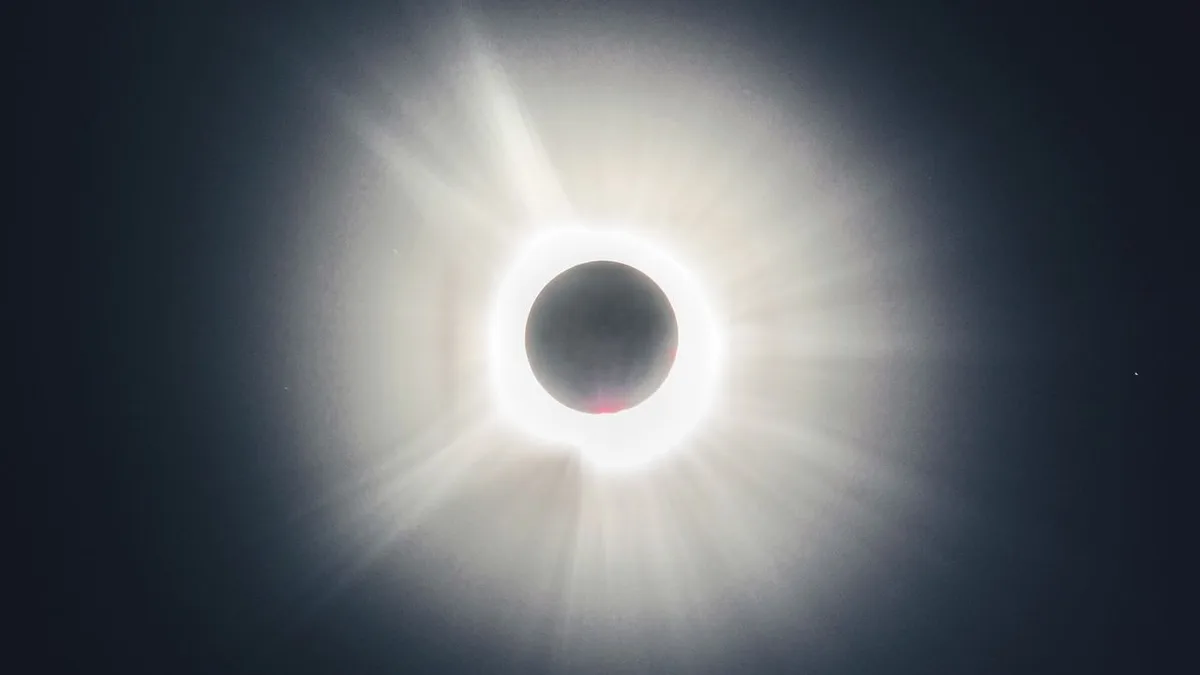
Totality during the total solar eclipse on April 8, 2024 (composite image). (Image credit: Space.com / Josh Dinner) Why it mattered The detection of helium during the 1868 eclipse was the first time spectroscopy revealed an element in an astronomical object that had not yet been discovered on Earth, and highlights why spectroscopy is one of astronomy’s most powerful tools.
Like every other element on the periodic table, helium has innumerable applications, including some that are especially important to space and spaceflight.
Scientists eventually learned that helium is the second-most abundant element in the universe (after hydrogen).
And the fusion of hydrogen into helium is the process that powers stars like our sun.
Helium gas is commonly used to pressurize and purge rocket propellant systems, and liquid helium is often used to cool sensitive scientific instruments on spacecraft.
The periodic table of the elements. (Image credit: Humdan/Shutterstock)
5News aggregated this summary from the outlet’s public feed. The full article, with all the context, is on www.space.com — the content belongs to Space.com.