Iran’s President Signals Willingness to Resume Peace Talks. What Stands in the Way?
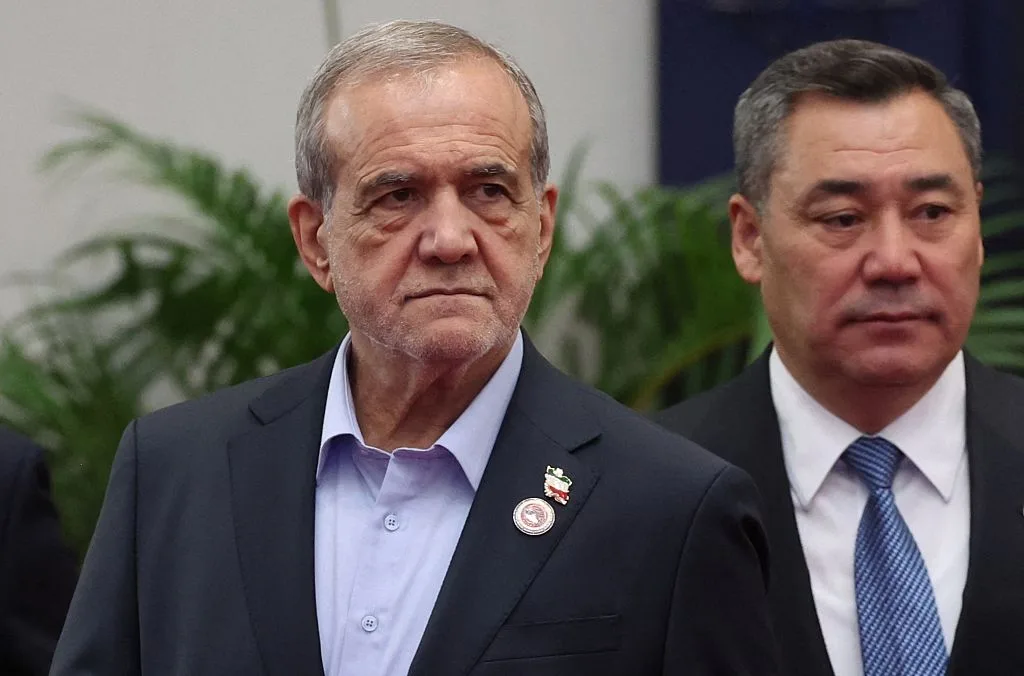
Iran's President Masoud Pezeshkian and Kyrgyzstan's President Sadyr Japarov arrive for a meeting of the Shanghai Cooperation Organization summit in Bishkek on Sept.
1, 2026. —Vyacheslav Prokofyev—POOL/AFP Iranian President Masoud Pezeshkian said Tuesday that Tehran is prepared to “reciprocate” if the United States is willing to return to the ceasefire conditions that both countries negotiated in June.
But the comments come at a time when Washington has signaled a strong commitment to sustained economic warfare—and launched fresh strikes against Iranian targets this week.
Speaking at the Shanghai Cooperation Organization summit—a high-level gathering of Eurasian leaders held this week in Kyrgyzstan—Pezeshkian told the press , “If the U.S. returns to its commitments in the memorandum of understanding (MoU), the Islamic Republic of Iran will immediately reciprocate.” Read More: Dire Strait: Why Economic Threats Might Escalate the War in Iran Pezeshkian’s words echo those of Foreign Minister Abbas Araghchi, who said on Monday that the U.S. must “return to its commitments and adhere to the memorandum’s terms; only then this situation will be resolved,” according to state media .
The MoU called for an immediate end to military operations and established a 60-day period for negotiating a final agreement.
The U.S. agreed to end its naval blockade, refrain from imposing new sanctions, and work on an economic reconstruction package during that time, while Iran agreed to clear the Strait of Hormuz of mines and allow trade through the vital passageway.
But the MoU collapsed when Washington and Tehran accused one another of violating its terms and failed to agree on the next steps toward reconciliation.
Fighting resumed in June, and Iran declared that the Strait of Hormuz was once again closed to maritime traffic.
Qatar, which formerly served as a mediator between the U.S. and Iran, said Tuesday that it supports efforts to rekindle peace talks.
“This escalation will not benefit anyone,” Qatar’s foreign ministry spokesman, Dr.
Majid Al-Ansari, told the press .
“We are all affected by this escalation.
Therefore we urge the parties, first, to exercise wisdom and return to the negotiating track, and we continue and intensify our efforts with our mediation partners to ensure a return to this track.” What’s blocking renewed U.S.-Iran peace talks? Finding a new path forward for the U.S. and Iran is complicated by resistance on multiple fronts.
The Iranian Students' News Agency reported that Pezeshkian was “clear” in his statement that Iran is “not seeking war.” But the President also faces internal pressure from the Islamic Revolutionary Guard Corps (IRGC), whose leaders have indicated that they are prepared to continue confronting the U.S.
5News aggregated this summary from the outlet’s public feed. The full article, with all the context, is on time.com — the content belongs to TIME.