The Iran war and tariffs are costing farmers. Will Republicans pay in November?
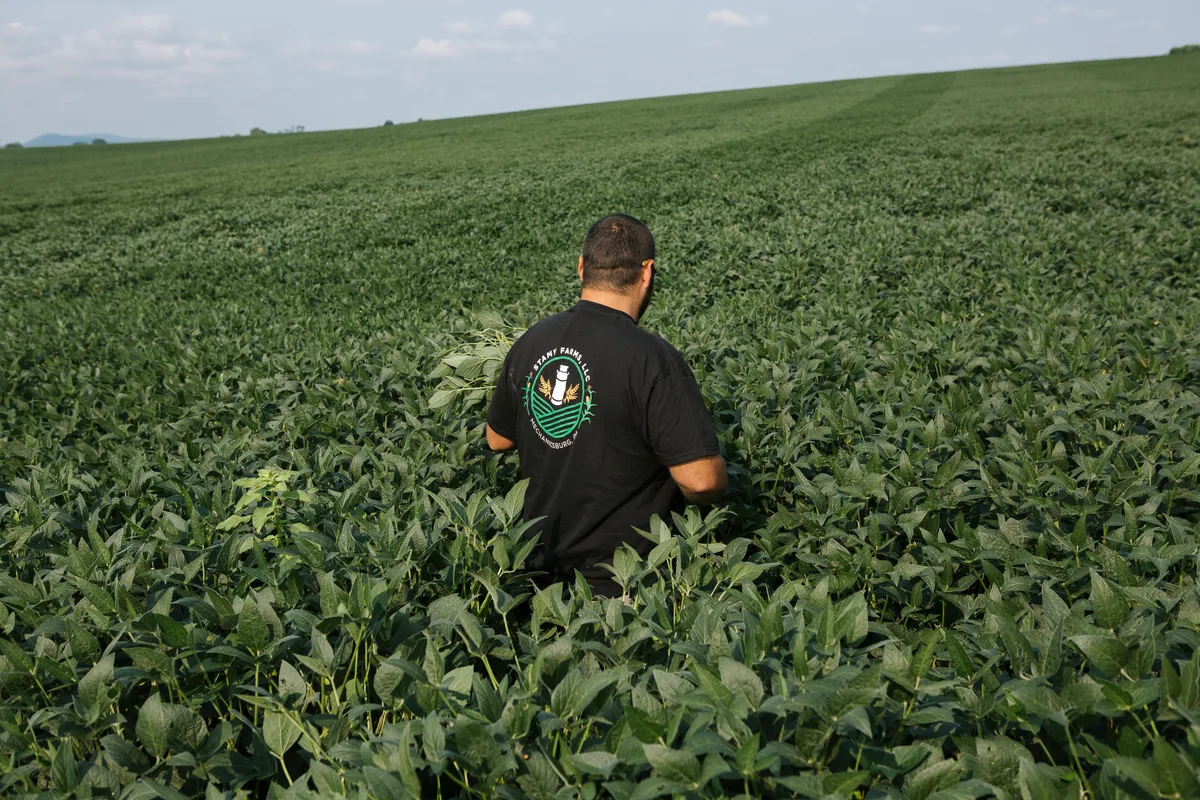
Ian Stamy, 38, a sixth-generation cash-crop soybean and grain farmer, walks into his field in Mechanicsburg, Pa., on Aug. 12. Stamy pivoted to soybeans and grain because he says dairy farming was no longer turning a profit. Michelle Gustafson for NPR hide caption
MECHANICSBURG, Pa. — Last year, Ian Stamy took the state prize for his bumper soybean yield, coaxing an average of just over 100 bushels per acre from his operation in central Pennsylvania. It's a title he's eager to defend this year — and so far, things look promising.
Wading into a sea of soybeans to grab a stalk by its roots, he says the weather has improved, but last month's record heat wave has him a bit concerned.
"We've been doing everything we can to push a little harder and try a little harder to maintain high yields and see what we can get," he says.
A cow painted on the side of one of his barns is a throwback to his family's six generations of dairy farming, but in 2018, he reversed course. The economics of dairy just didn't work any longer, he says. Now he's all in on soybeans and corn and is excited about this fall's harvest. He acknowledges, though, that it's hard to predict yields until the combines start rolling.
The side of a barn at Stamy Farms in Mechanicsburg, Pa., on Aug. 12. Michelle Gustafson for NPR hide caption
Corn stored in a grain silo is seen at Stamy Farms. Michelle Gustafson for NPR hide caption
Dry conditions aren't his only challenge this year. Stamy and other farmers NPR spoke to for this story say the cost of keeping a farm running — including fertilizer and diesel fuel for farm equipment — has risen sharply. Those higher costs come on top of President Trump's trade disputes, which have reduced agricultural exports to Canada and China . China, the world's biggest importer of soybeans , responded by turning to other suppliers, such as Brazil . In 2017, the South American country overtook the U.S. as the world's largest soybean producer, and now it supplies 65% of Beijing's needs .
Stamy, 38, who grows about 1,200 acres of soybeans, says price volatility has been "ridiculous" in the last two years. "You think you're heading in the right direction. … You're trying to look ahead at weather events and stuff like that. And then something else happens, bombing or war, and then it changes the whole game."
He doesn't explicitly hold Trump responsible for these challenges, but recent polling suggests that discontent among farmers — long a stalwart of the Make America Great Again coalition — is increasing.
In 2024, more than three-quarters of the country's farming-dependent counties helped return Trump to the White House. But in the following year, farm bankruptcies spiked across much of the country, according to the American Farm Bureau Federation.
In an April 2026 survey of 974 farmers in 44 states commissioned by Amato Advisors and conducted by Farm Journal , 78% said machinery and other key costs, including fertilizer, fuel, seed and chemicals, were among their top three concerns, and 94% said the war with Iran was increasing those costs.
5News aggregated this summary from the outlet’s public feed. The full article, with all the context, is on www.npr.org — the content belongs to NPR.