Life on Mars? It Remains a Tantalizing Topic for Scientific Study
What if we aren’t alone in the universe? People have been speculating about the possibility of alien life forms at least since Lucian’s A True Story, some 1,800 years ago. In modern times, much of that has centered on our near neighbor Mars.
Sometimes those life forms are dangerous, probably never more so than in the various versions of The War of the Worlds. Sometimes they’re more congenial, as in the ’60s sitcom My Favorite Martian. Either way, we can’t stop wondering, what if?
The fiction is fun, but it’s science that will answer the question more definitively. And the science has been getting closer to the mark since astronomer Percival Lowell theorized in 1890 that intelligent life built a series of canals on the red planet.
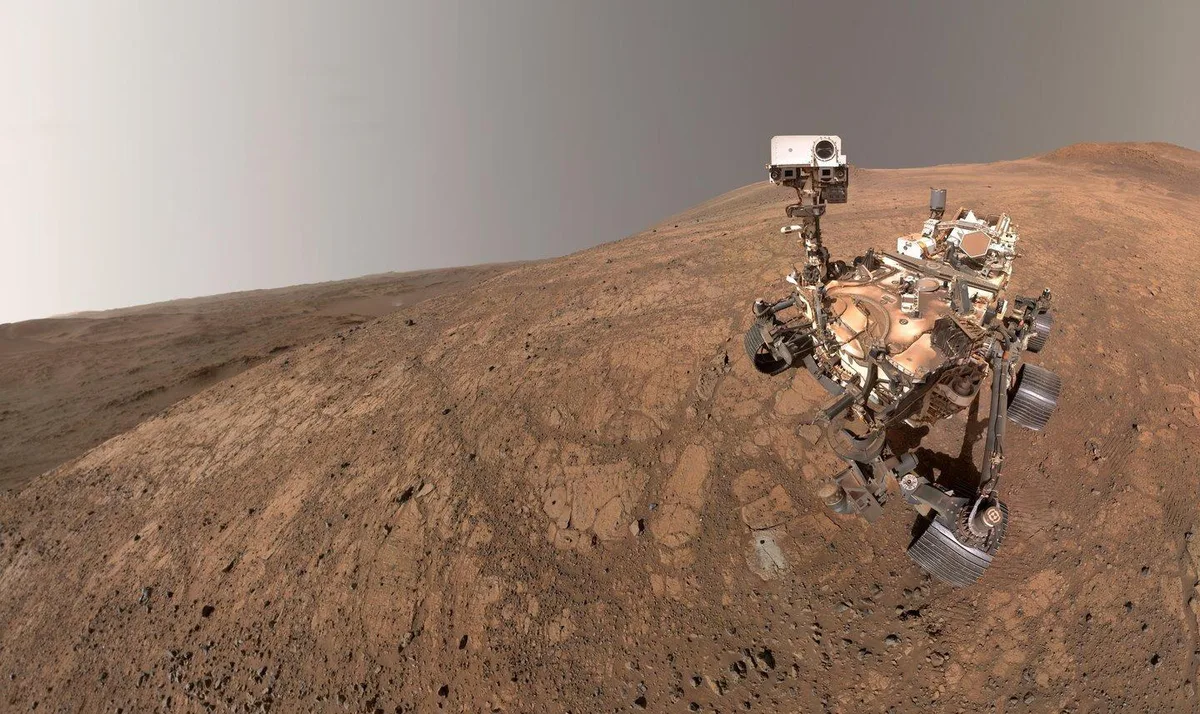
Nowadays we have landers and rovers on the Martian surface, and spacecraft making observations from orbit. We may even get boots on the ground in the years ahead, whether through NASA’s eventual follow-ons to the Artemis moon missions or courtesy of would-be Mars colonizer Elon Musk (though he has missed his original target of 2025 ).
It helps that Mars is the nearest planet that isn’t a toxic hellscape with surface temperatures hot enough to melt lead. There are theories about life on Venus , but until scientists can create something that survives longer than 2 hours on the surface, Venus isn’t really in the conversation.
It’s a complex question because many factors have to align for a planet to support life. It has to be in the habitable zone of a star, close enough to support liquid water but far enough away to not get scorched . It also needs an atmosphere to hold in some of that heat and a rocky surface so that life has somewhere to live. That rocky surface could be covered in water, but the point is that it can’t be a gas giant like Jupiter.
Once you get that right, the planet needs the right mass and gravity and a molten core of liquid metal to generate a magnetic field, which protects the surface against the most harmful rays that come from the host sun. The correct chemical ingredients must also be present, since life can’t exist without the fundamental building blocks, such as carbon, hydrogen, nitrogen, oxygen and phosphorus. All of these elements have to work in balance with one another to create an ecosystem that is just right for supporting life.
It puts into perspective just how special Earth is when it comes to supporting life, as it has maintained this delicate balance for billions of years.
Mars doesn’t have all of those ingredients anymore, but according to 60 years of research, it used to, so it remains Earth’s best lead for finding signs of extraterrestrial life, even if it has long since gone extinct.
There is no shortage of research about Mars. A study in 2025 counted a little over 10,000 studies published between 2001 and 2024, and that’s just what’s being used to train AI. Here’s a rough look at what decades of scientific projects have revealed about our neighboring planet.
For centuries, humans expected to find water on Mars. Astronomers were able to see ice caps on Mars through telescopes long before we became a spacefaring species.
5News aggregated this summary from the outlet’s public feed. The full article, with all the context, is on www.cnet.com — the content belongs to CNET.