An Inflection Point for Prediction Markets
This is an edition of The Atlantic Daily, a newsletter that guides you through the biggest stories of the day, helps you discover new ideas, and recommends the best in culture.
Sign up for it here.
The day before Donald Trump’s second State of the Union address, the former Representative George Santos shared a video of himself saying, in no uncertain terms, that he was “going to be there.” The next day, he didn’t show up.
According to the prediction-market company Kalshi, that was the plan—the firm alleged that he made roughly $17,000 by betting on the platform that he wouldn’t appear at the speech.
Kalshi flagged the wager to federal authorities, and the Commodity Futures Trading Commission (CFTC), the agency that regulates prediction markets, fined Santos over it in July.
On Monday, Kalshi doubled down, levying a fine of its own and giving him the platform’s first-ever lifetime ban.
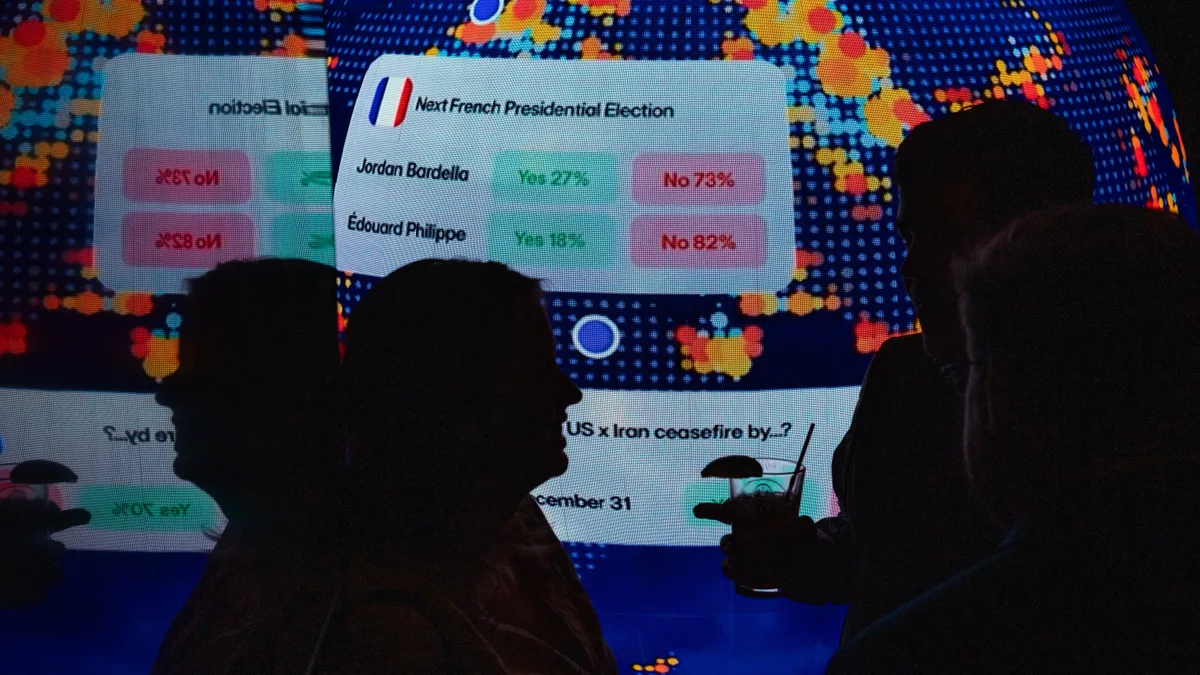
Prediction-market companies, which let users make bets on the outcomes of all sorts of real-world events, have fully entered the mainstream over the past few years.
You can find their logos at major sporting events , on cable-news broadcasts , and at awards shows .
They’re easy to access and, thanks to a recent advertising blitz, essentially ubiquitous.
Trading volumes on Kalshi and Polymarket, the two market leaders, have exceeded $200 billion and $100 billion this year, respectively.
But these companies have strenuously resisted the idea that they should be thought of as gambling platforms.
“I just don’t really know what this has to do with gambling,” Kalshi CEO Tarek Mansour said of his company last year. (By avoiding this classification, prediction markets have also been able to operate in states where sports betting is banned.) Instead, Kalshi and Polymarket have suggested that their platforms are digital oracles: potent indicators of what the future might hold, fueled by the wisdom of the crowd.
In recent months, a nascent crackdown on insider trading has been exposing a fundamental tension in these companies’ guiding principles.
If the goal is to create fair markets and not get targeted by the government, then they must enforce a ban on insider trading, as U.S. regulators already do .
5News aggregated this summary from the outlet’s public feed. The full article, with all the context, is on www.theatlantic.com — the content belongs to The Atlantic.