Baby elephant at National Zoo helps lead fight against deadly disease
Elephant endotheliotropic herpesvirus is the leading cause of death in young Asian elephants. One baby elephant is at the center of an effort that could transform how the disease is managed in these gentle giants worldwide. Deema Zein reports.
Notice: Transcripts are machine and human generated and lightly edited for accuracy. They may contain errors.
A disease that's the leading cause of death among young Asian elephants has been extremely hard for scientists to combat. But a baby elephant at the National Zoo here in Washington, D.C., is giving them a chance to try a new approach.
The "News Hour"'s Deema Zein went to meet the young little calf at the center of their efforts.
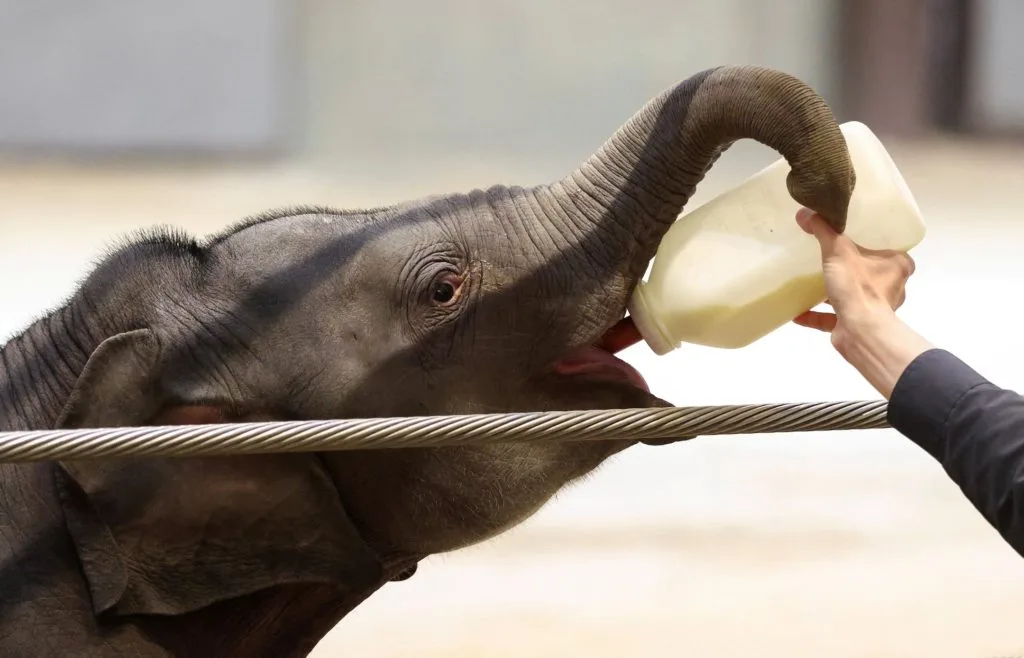
Fueling up on elephant formula, following in the footsteps of her older aunties, and taking a quick dip, every day is an adventure for Linh Mai, the National Zoo's baby elephant, the first born here in 25 years. And she's already a hit.
She's the result of the zoo's yearslong process to build a herd that would aid in the survival of endangered Asian elephants.
But the elephant in the room, calves like Linh Mai, are vulnerable to an often deadly disease. It's called elephant endotheliotropic herpesvirus, or EEHV, and all Asian elephants will get it in their lifetime. While it stays latent in some, roughly 60 percent of baby elephants that develop the disease will die from it.
Tony Barthel, Director of Animal Care, Smithsonian's National Zoo: That's an insidious disease that really has a significant impact on this species.
Tony Barthel is the director of animal care at the Smithsonian's National Zoo.
After that immunity is dissipated, they can have a real crisis. And they can go from your first subtle symptom to death in a day. It can be dramatic. And so cracking that nut is a massive focus of ours here too.
So, this year, the zoo's animal care and vet teams are testing a new approach to manage the disease. Their hope, to expose Linh Mai to EEHV now, while she still has strong antibodies from her mom to fight it.
If we can take hold of the narrative in some ways where we can help expose Linh Mai at times when she is most apt to fight the infection off.
Gives us the best ability for her to survive the infection and also then develop lifelong immunity to it.
The elephant lowers its trunk, blowing that mucus-filled fluid into a sample bag, collected and sent over to the zoo's EEHV lab for testing. And, slowly, Linh Mai is exposed to those positive EEHV samples herself via syringe.
5News aggregated this summary from the outlet’s public feed. The full article, with all the context, is on www.pbs.org — the content belongs to PBS NewsHour.