Neuroscientists have vastly underestimated brain cells’ computing power
Neuroscientists have vastly underestimated brain cells’ computing power
A new study shows that each neuron can do multiple computations at once thanks to hundreds of sprawling branches
One of the central mysteries of the brain is how it achieves so much with so little. At any given moment, it processes an entire world of input , pilots a body and generates conscious experience —all with relatively modest energy demands. Traditionally, the brain’s 86 billion neurons are each assumed to be a single “processor,” operating as one computational unit. But for the past few decades, neuroscientists have suspected that a neuron might actually house many processors, making it far more powerful. Now researchers have found the first direct evidence of this in animals, showing that neurons’ many branches, called dendrites, can compute information independently of the cell body.
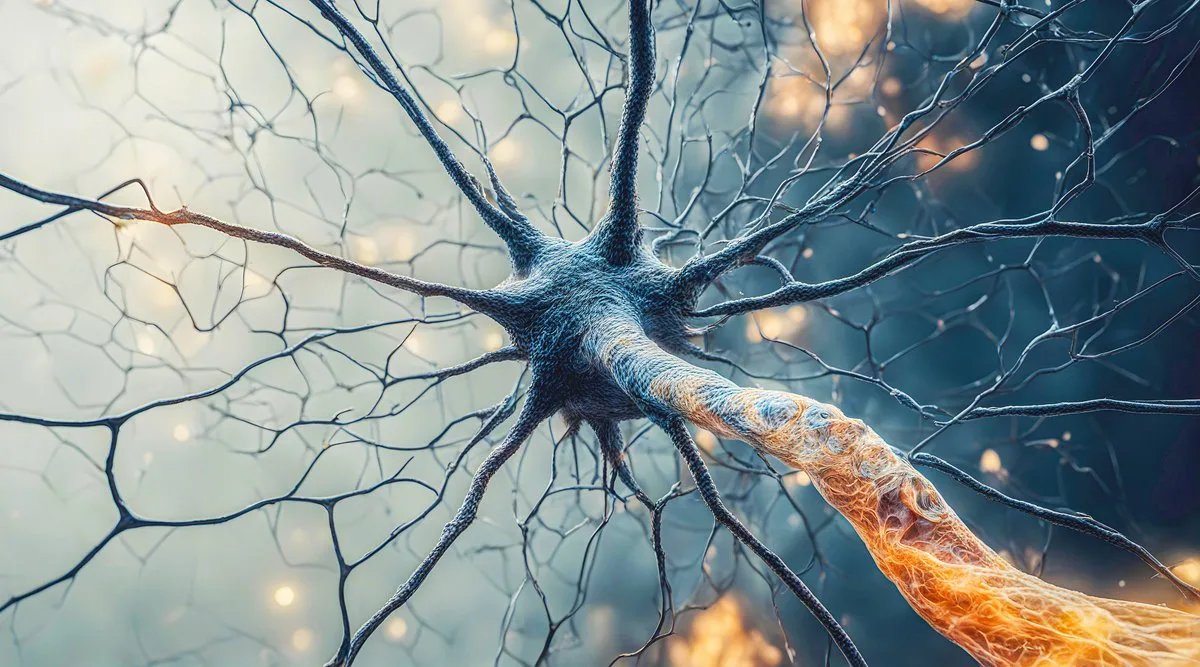
The study, published in July in Science , shows that dendrites “dramatically expand” the computational capacity of individual neurons and, consequently, of the brain as a whole, says senior author Attila Losonczy, a neuroscientist at the University of Texas Southwestern Medical Center. Neurons in textbook diagrams look deceptively simple, with only a handful of dendrites extending from the cell body. In reality, they sprawl wildly into elaborate treelike arbors, allowing a single neuron to receive input from thousands of its neighbors. Scientists once thought these dendrites were little more than “boring cables” that merely passed incoming signals to the cell body for processing, Losonczy says. If this were true, each neuron would essentially be one computational unit.
But dendrites’ sprawling architecture hints at a deeper purpose. “Nature puts a lot of effort and energy to maintain those branched structures,” Losonczy says. For the past 30 years, experiments on lab-grown neurons and excised brain tissue have suggested that dendrites could compute information on their own. To test the idea in living animals, Losonczy’s team used new voltage-imaging technology to record activity from parts of individual neurons in mice’s hippocampi, a brain region involved in memory and navigation. While running on miniature wheels, the mice navigated virtual environments in search of rewards.
If you're enjoying this article, consider supporting our award-winning journalism by subscribing . By purchasing a subscription you are helping to ensure the future of impactful stories about the discoveries and ideas shaping our world today.
In familiar environments, activity in the dendrites generally matched that of the cell body. And when the researchers moved the reward around within the familiar surroundings, the cell body adjusted quickly, while certain dendrites retained remnants of the earlier activity. But in an entirely new environment, some dendrites changed their activity to represent the new location before the cell body, which caught up only after repeated exploration.
5News aggregated this summary from the outlet’s public feed. The full article, with all the context, is on www.scientificamerican.com — the content belongs to Scientific American.