We've flown a radiation-blocking vest to the Moon and back, and it worked
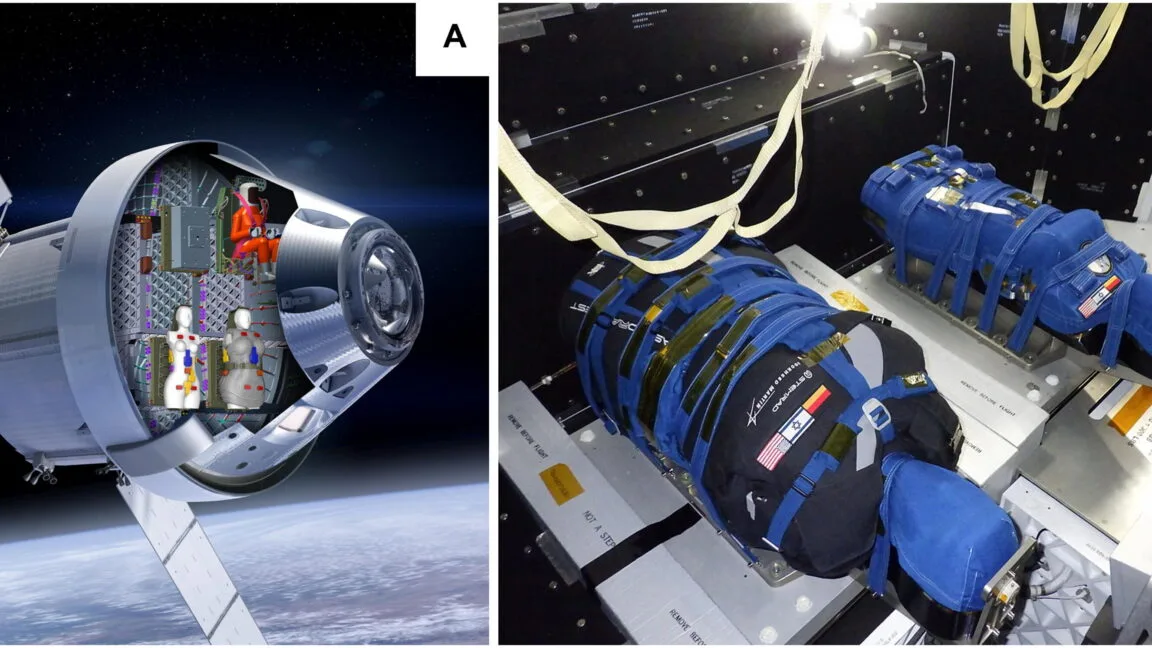
Solar storms, like the one in August 1972 that hit during the gap between the Apollo 16 and Apollo 17 missions, throw bursts of protons intense enough to raise an astronaut’s cancer risk or even cause radiation sickness. Earth’s atmosphere and magnetic field absorb this radiation, but crews heading to the Moon or Mars won’t have that protection, and no spacecraft built so far has enough shielding to stop it.
A team led by Jordan Houri and Oren Milstein of StemRad, an Israeli-American startup developing personal protective equipment against radiation, proposed that we could solve this by shielding the astronauts instead of shielding the spacecraft.
To test this idea, StemRad’s team flew a wearable radiation-shielding vest called AstroRad to the Moon and back aboard NASA’s uncrewed Artemis I mission, then used the flight data to calculate how it would perform during an actual solar storm. It turns out the vest would perform roughly as well as the Orion’s heavily shielded onboard shelter the crew was supposed to hide in to wait out a storm.
Spacecraft designers have spent decades weighing shielding options, from aluminum hulls to water-filled walls to superconducting magnets that would deflect charged particles before they reach the crew. All of them run into the same challenge. “The question was how to use mass in a very efficient way,” Milstein says. “Mass is really the bottleneck—every gram counts.”
A shielding garment an astronaut could wear is simultaneously sensible and ridiculous. The ridiculous part was that, for a long time, people thought that a protective garment would need to look like full-plate armor in order to offer meaningful protection. It would presumably need to be made of lead or other high-density materials that would add mass and make moving around nearly impossible.
StemRad engineers, though, figured dressing as a medieval knight doesn’t really get you all that much. The human body, Milstein explains, isn’t uniformly vulnerable to radiation. “Tissues like the bone marrow are a lot more sensitive to radiation compared to the brain,” he says. Following this idea, StemRad developed a belt for nuclear first responders, worn around the hips, which hold roughly half the body’s bone marrow, the tissue that makes blood cells. Protecting even a fraction of the bone marrow lets a person regrow it and survive a high-dose exposure.
So, StemRad, working with Lockheed Martin, expanded this idea into a female vest that, aside from the hips, also covered the breasts, stomach, colon, and reproductive organs. These are all less immediately life-threatening when irradiated, but carry a long-term cancer risk.
“It still gets people surprised,” Milstein says. “Everybody asks, what about the head? But we’re actually able to reduce the effective dose by 60 percent without protecting the head, the arms, or even the legs.” But choosing where to put shielding was just one part of the problem. Picking the material and making a design that would not hinder the astronaut’s movements was another.
“The primary factor in how effective a shielding material is is its atomic number divided by its atomic mass,” Houri says.
5News aggregated this summary from the outlet’s public feed. The full article, with all the context, is on arstechnica.com — the content belongs to Ars Technica.