Roy Cohn Did It First
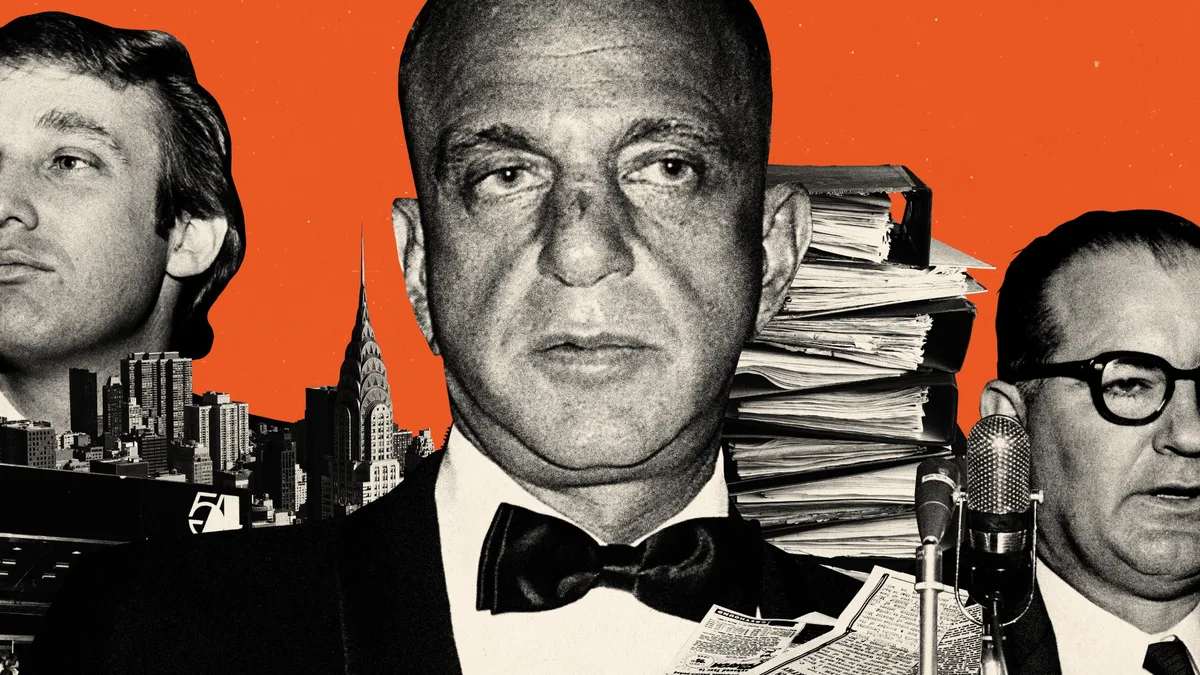
The day after Donald Trump won the 2016 election, the conservative political operative Roger Stone was among the lucky few to get through to him on the telephone.
The president-elect reminisced about the long-dead friend who had introduced him to Stone: “Wouldn’t Roy love to see this moment? Boy, do we miss him.” “Roy” was Roy Cohn, who became notorious in the early 1950s as chief counsel to Senator Joseph McCarthy and then built a career as a lawyer and fixer for New York City’s rich and powerful.
His roster of clients, many of whom doubled as his friends, included Cardinal Francis Spellman, George Steinbrenner, the media mogul Si Newhouse, and a host of famous mafiosi, including “Fat Tony” Salerno and John Gotti.
Trump met Cohn in 1973, when the young developer sought advice about a federal lawsuit alleging racial discrimination by his family’s real-estate company.
Cohn proposed countersuing the feds for defamation—even though the company had been marking the applications of prospective Black tenants with a large C , for “colored,” and then telling them no apartments were available.
The countersuit, for $100 million, failed as a legal tactic—the company settled with the Justice Department, without admitting wrongdoing, after two years of litigation—but it made headlines, which was the real point.
Trump and Cohn had the same attitude toward the law: It was not a system of rules, but a way of getting what you wanted.
For a generation of liberal Manhattanites, the mere mention of Cohn’s name produced a visceral loathing.
They saw him as a self-serving and unprincipled social climber whose crusade against communism had ruined lives.
In documentaries , profiles , and the play Angels in America , he has been portrayed as a villain in the vein of Shakespeare’s Richard III, whose monstrousness can be traced back to his own sense of social exclusion.
When Cohn contracted AIDS, he kept his illness and his sexuality secret to the end.
He died in 1986 insisting that he had liver cancer, even while enrolled in a clinical trial to receive AZT, an early AIDS medication.
In American Scoundrel: Roy Cohn’s Dark Journey From Joe McCarthy to Donald Trump , Kai Bird—writing with his wife, Susan Goldmark, whom he credits with contributing significant research—aims to bring Cohn into focus as a progenitor of Trump.
Bird’s previous work as a biographer has focused on distinguished statesmen and scientists of the mid-20th century, most notably the left-leaning nuclear physicist J.
5News aggregated this summary from the outlet’s public feed. The full article, with all the context, is on www.theatlantic.com — the content belongs to The Atlantic.