Black Hole Stars Are Apparently Real and Help Explain a Long-Standing Mystery
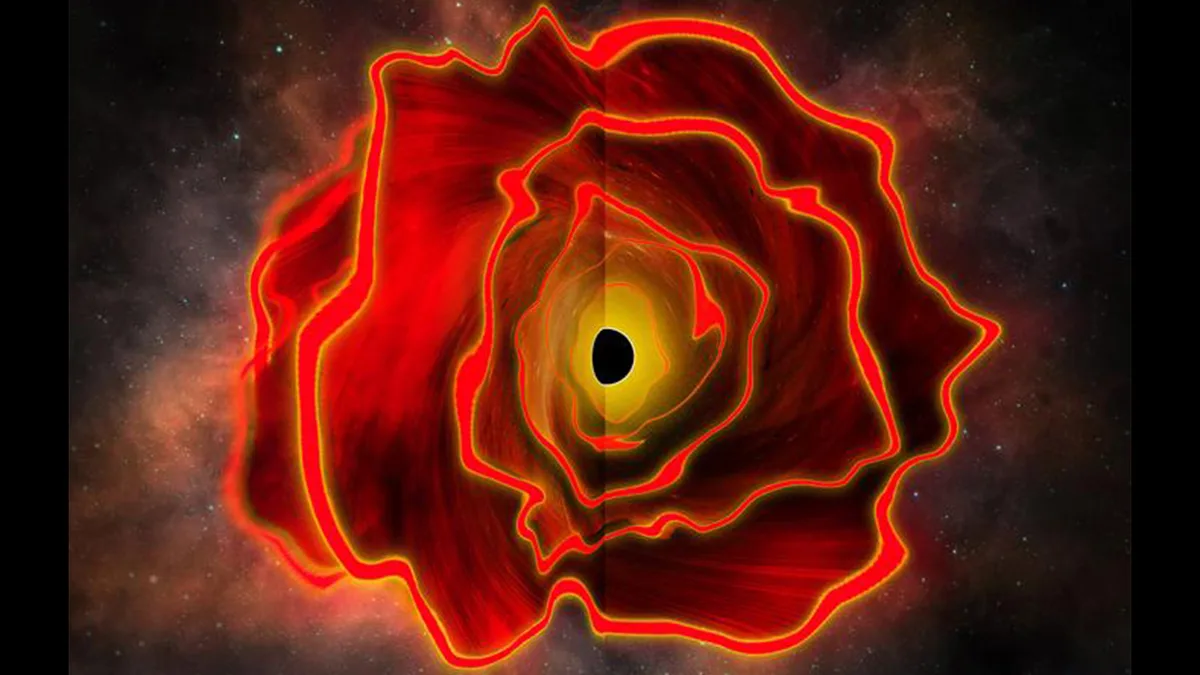
It’s time to cue up some Chris Cornell and get in the mood, because astronomers may have found a real black hole sun. While the Soundgarden frontman wrote the 1994 song after mishearing a news broadcast, the black hole star we’re talking about today is likely very real.
Astronomers have been studying the half-black hole, half-star object, known formally as MoM-BH*-1, and this week published the results of their analysis in the journal Nature . The object bears a striking resemblance to a star, thanks to its outer shell of very hot and dense gas. It exhibits other starlike behaviors as well, especially when viewed with the NIRSpec instrument on NASA’s James Webb Space Telescope .
But there are some notable differences when compared to other stars. MoM-BH*-1 has a black hole at the center instead of a molten core like a traditional star. It’s also the size of our entire solar system and puts out over 100 billion times the amount of energy of any known star. The energy output is more in line with what astronomers have measured from black holes. It also exhibited some traits unlike anything else ever observed.
This got Naidu and the other researchers thinking that the object might be something completely new. They weren’t even looking for a black hole star. They were using the James Webb Space Telescope to search for the oldest galaxies in the known universe and to learn more about how they formed. Naidu believes they may have uncovered two pieces of the puzzle at once, as these black hole stars could have played a role in the formation of early galaxies.
“These are not stars in a literal sense,” Naidu told CNET in an email. “These are objects that show features traditionally associated with black holes as well as those classically seen in stars. The physical configuration that can produce these hybrid features involves a dense cocoon of gas enveloping the black hole.”
Naidu says that the black hole is likely consuming the material on the inside of the star, and that in this case, the cocoon of dense gas is simply acting as a substitute for the standard accretion disk, which is the accumulated material encircling a black hole ahead of being consumed by it.
The James Webb Space Telescope launched in 2021 and began observing the universe in July 2022. It almost immediately began finding a series of mysterious objects that researchers call little red dots, since that’s how they appear in scans. Research has turned up 341 little red dots as of this writing, and due to limitations of the telescope’s instruments, researchers haven’t been able to figure out what they are.
“These little red dots seem to be everywhere in the early universe, but essentially disappear by the present day,” Naidu said in a statement issued by MIT . “What exactly these objects are has been one of the most debated topics of the JWST era.”
For instance, Vasily Kokorev at the University of Texas at Austin, used Naidu’s research to posit that perhaps every little red dot was a black hole star. Wendy Sun, an astronomy research assistant at the University of Hawaii, presented additional evidence based on Naidu’s research.
5News aggregated this summary from the outlet’s public feed. The full article, with all the context, is on www.cnet.com — the content belongs to CNET.