When housing is unaffordable, this artist’s device makes pedaling harder
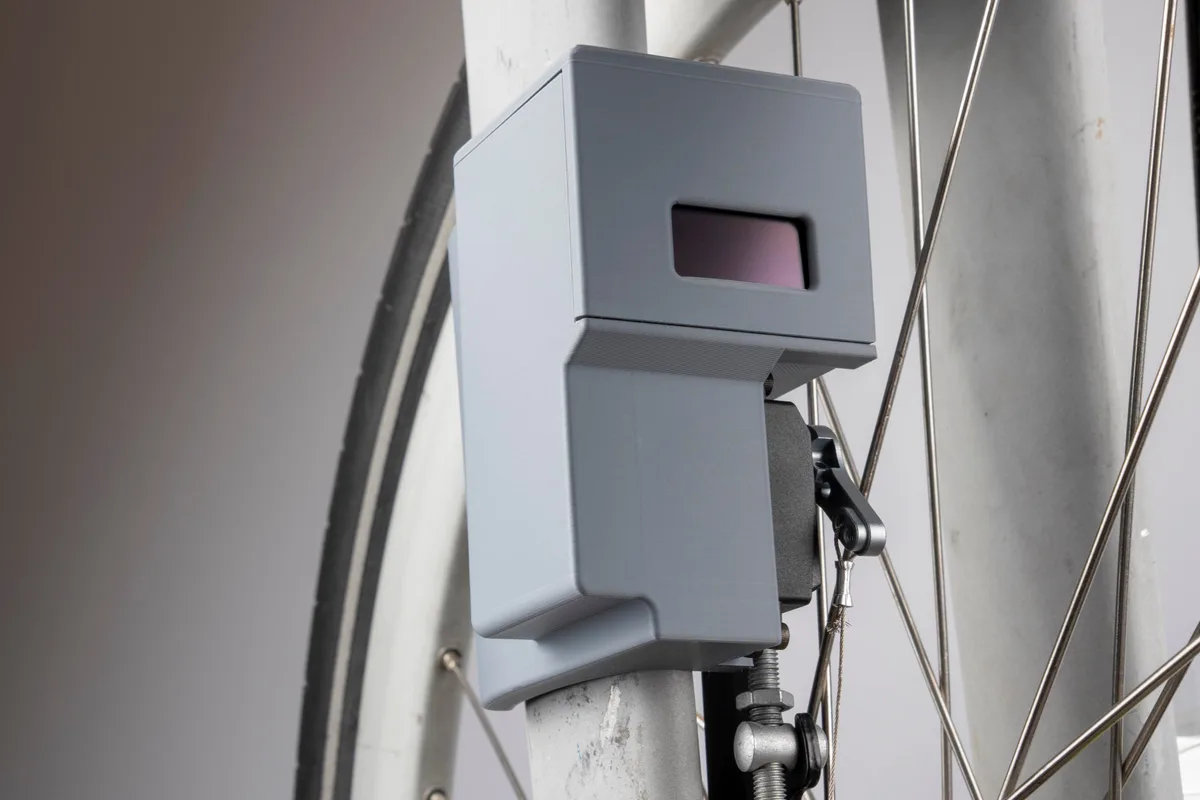
Brooklyn-based artist Justin Blinder created a device that illustrates how soaring housing costs are making life in the city that much harder.
Brooklyn-based artist Justin Blinder created a device that illustrates how soaring housing costs are making life in the city that much harder.
Justin Blinder had just been laid off when he first came up with the idea for Ground Truth. It was 2020, two weeks before covid lockdown went into effect, and the Brooklyn-based artist and technologist had no idea what the future would hold. He started working for the food delivery apps, and as he was riding his bike across the city, he began noticing the stark differences between neighborhoods.
“I really started to kind of become a bit more aware of how different neighborhoods, often right next to each other, could feel very economically and psychologically very far apart, even though it’s just really within close proximity,” he said. “And also just how those inequalities can sometimes feel quite unusually physical. A lot of times higher elevation can contribute to the desirability and cost of a neighborhood through better views and lower flood exposure.”
These observations led him to think about the relationship between the food he was delivering, the neighborhoods it was going to, the buildings he encountered, and even the expectations he developed about potential tips.
“All that kind of culminated into this sort of line of thinking that led to Ground Truth that had been percolating after that for a few years,” Blinder said.
Ground Truth , Blinder’s new art project, is a small gray box that attaches to the front fork of a bike and changes the physical difficulty of riding according to the housing affordability of the surrounding neighborhood. When housing is more affordable, pedaling becomes easier. But when a rider enters an area where housing costs consume a larger proportion of residents’ incomes, the bike’s resistance increases, making the rider work harder.
“And so it’s really thinking about how to take economic abstractions in this case, really the affordability of cost-of-living prices, and turn them from something that really reduces people to numbers and brings it back into more of a direct physical experience that’s rooted in reality and in the streets,” he said.
After abandoning some early ideas for fear of unexpected legal consequences, Blinder settled on building an external mechanism that would allow him to affect the bike without penetrating its closed electronic systems. Using a Citi Bike as his “canvas,” he noticed that the front drum-brake mechanism was physically exposed. When the rider pulls the front brake handle, a lever on the front fork moves to apply pressure. He realized he could build a wireless mechanism that attaches to this lever and effectively acts as an additional brake actuator, allowing the device to increase or decrease the bike’s resistance.
The hardware itself is relatively simple, consisting of an ESP32-S3 microcontroller, a GPS module, a high-torque servo motor capable of precisely controlling its rotation, and an SD card reader for storing the data set locally.
5News aggregated this summary from the outlet’s public feed. The full article, with all the context, is on www.theverge.com — the content belongs to The Verge.