Drone time lapse shows total solar eclipse in amazing 4K quality
This article is part of a special report on the total solar eclipse that offered the best views from the Arctic Circle, Iceland, Spain and parts of Portugal on August 12, 2026.
The 2026 total solar eclipse has come and gone, but that doesn’t mean the wonder has to end.
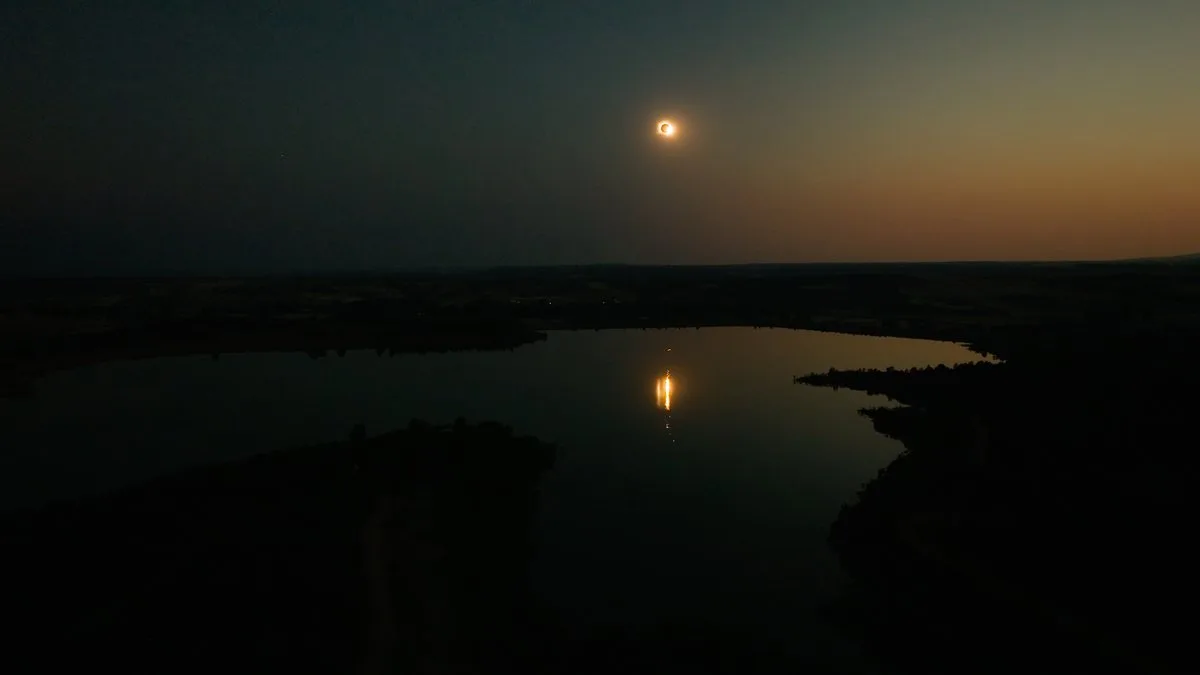
Scientific American contributor and eclipse chaser Lucie McCormick watched the eclipse unfold from central Spain, where she recorded and photographed the event with a drone, as well as ground-based cameras. Using those drone-captured images, McCormick has created a stunning time-lapse video showing the eclipse from beginning to end.
In the time lapse, the setting sun disappears behind the moon as our natural satellite moves directly in front of the star. During this period of totality—which had lasted just more than a minute in real time—you can see the entire landscape plunged into darkness, leaving only a halo of orange light in the sky.
If you're enjoying this article, consider supporting our award-winning journalism by subscribing . By purchasing a subscription you are helping to ensure the future of impactful stories about the discoveries and ideas shaping our world today.
To learn more about this solar eclipse, read our full eclipse guide . And if you feel inspired to try and catch the next one yourself, check out McCormick’s tips and tricks for safely photographing an eclipse using any camera.
If you enjoyed this article, I’d like to ask for your support. Scientific American has served as an advocate for science and industry for 180 years, and right now may be the most critical moment in that two-century history.
SciAm always educates and delights me, and inspires a sense of awe for our vast, beautiful universe. I hope it does that for you, too.
If you subscribe to Scientific American , you help ensure that our coverage is centered on meaningful research and discovery; that we have the resources to report on the decisions that threaten labs across the U.S.; and that we support both budding and working scientists at a time when the value of science itself too often goes unrecognized.
There has never been a more important time for us to stand up and show why science matters. I hope you’ll support us in that mission.
5News aggregated this summary from the outlet’s public feed. The full article, with all the context, is on www.scientificamerican.com — the content belongs to Scientific American.