What Is Trump’s U.S. Space Academy?
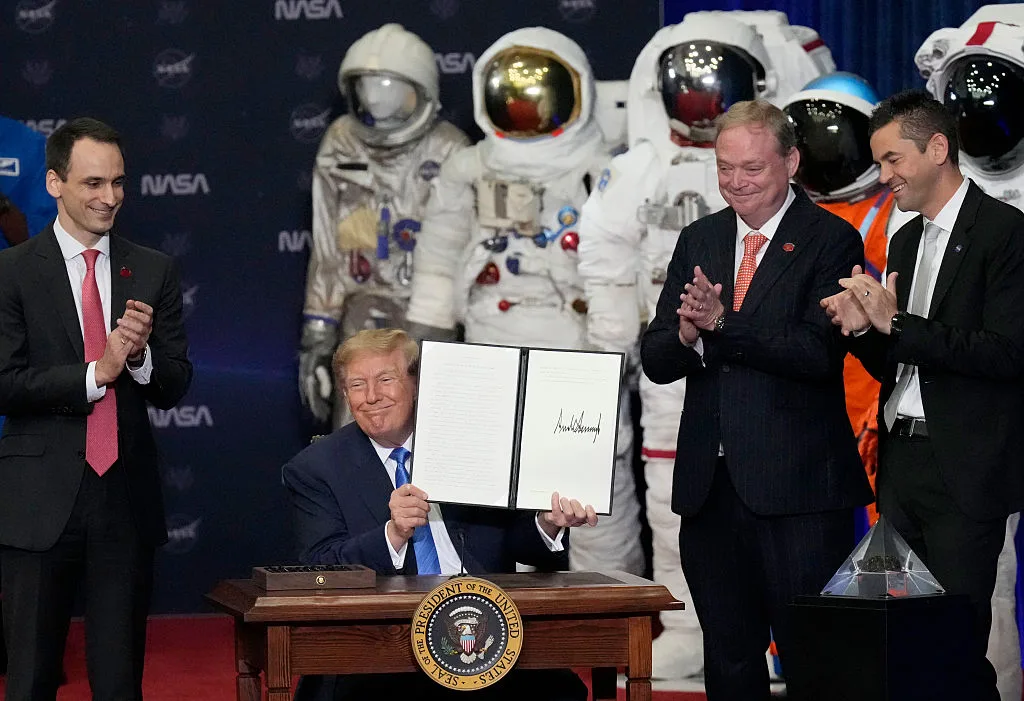
President Donald Trump signs an executive order to begin creating a U.S.
Space Academy during the Congressional Space Medal of Honor ceremony at NASA's Johnson Space Center in Houston on Aug.
28, 2026. —Melissa Phillip—Houston Chronicle via Getty Images President Donald Trump last week signed an executive order creating a commission to develop plans for the United States Space Academy, which is intended to “educate and develop the next generation of leaders across the space domain.” The initiative was first announced when Trump visited the Lyndon B.
Johnson Space Center in Houston, Texas, on Aug.
28 to present the crew of Artemis II with the Congressional Space Medal of Honor.
The crew was recognized for their 10-day lunar flyby in April, which took them farther from Earth than any human had ever traveled.
“Given the rapid growth of the Space Force and the commercial space industry and the expansion of our ambitions to the moon and far beyond the moon,” Trump said while giving remarks at the ceremony, “it’s clear we will need to educate and train an entire generation of skilled service members, engineers, and civil operators.” The proposed academy is envisioned as serving the military, civil government, and broader space industry.
However, the exact admissions requirements for Space Academy—which will help characterize who it serves and how—are yet to be determined.
Future Space Force officers currently attend the U.S.
Air Force Academy.
Read More: U.S.
Says Chinese Hackers Targeted Senate, NASA, Hospitals, and More “The Nation must prepare the next generation of astronauts, scientists, engineers, operators, entrepreneurs, civil servants, and warfighters and ensure that they are capable of advancing American interests in space,” the executive order said.
“Achieving this goal requires us to recruit, train, and retain America’s best and brightest from across the Nation.” At the ceremony, Trump also acknowledged the Nancy Grace Roman Space Telescope , named for one of the forebears of modern space science, which was launched Sunday aboard a SpaceX Falcon Heavy.
With surveying capabilities over 1,000 times faster than its predecessor, the Hubble Space Telescope, Roman seeks to explore dark matter, uncharted corners of the cosmos, and questions about the expansion of the universe.
5News aggregated this summary from the outlet’s public feed. The full article, with all the context, is on time.com — the content belongs to TIME.