Sunday, October 18, 2026 SourcesAbout🌓
🇺🇸 US ▾
BREAKING
› The beloved Dyson Supersonic hair dryer is at its lowest price ever› Everything you need to know about Way Day 2023, Wayfair's biggest sale of the year› The 10 best Amazon deals to shop this week› The 2024 presidential alternative many voters will want› Dominion still has pending lawsuits against election deniers such as Rudy Giuliani and Sidney Powell› Russia is 'going backwards' in equipment and deploying post WWII-era tanks, according to Western officials› Podcast: One country musician is calling for other artists to oppose assault rifles› Bidets save you money and reduce waste — we tested the best options out there› 50+ products to make your life easier and our planet cleaner› Mother's Day is around the corner. Here are 50+ thoughtful gifts she'll love› The beloved Dyson Supersonic hair dryer is at its lowest price ever› Everything you need to know about Way Day 2023, Wayfair's biggest sale of the year› The 10 best Amazon deals to shop this week› The 2024 presidential alternative many voters will want› Dominion still has pending lawsuits against election deniers such as Rudy Giuliani and Sidney Powell› Russia is 'going backwards' in equipment and deploying post WWII-era tanks, according to Western officials› Podcast: One country musician is calling for other artists to oppose assault rifles› Bidets save you money and reduce waste — we tested the best options out there› 50+ products to make your life easier and our planet cleaner› Mother's Day is around the corner. Here are 50+ thoughtful gifts she'll love
Technology

Have physicists finally discovered glueballs? New evidence points to yes.
Ars Technica ·
Have physicists finally discovered glueballs? New evidence points to yes.

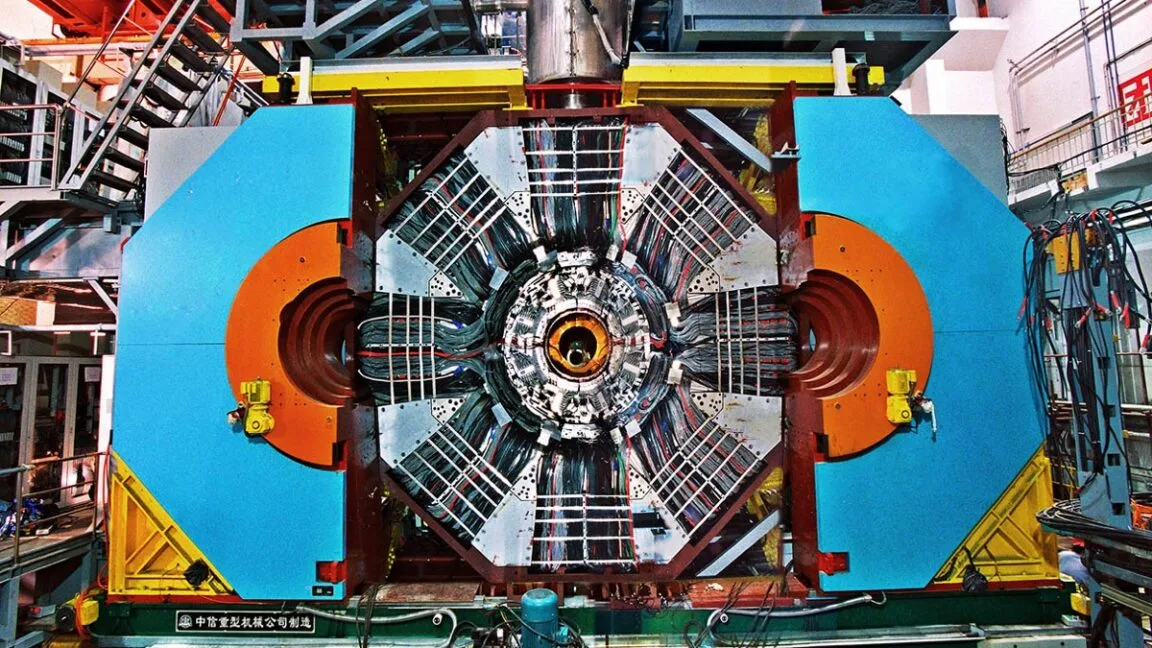
Physicists with the Beijing Spectrometer III (BES III) experiment have uncovered convincing new evidence of the existence of so-called glueballs , an elusive composite particle made entirely of gluons predicted by quantum theory.

The results appeared in a preprint posted to arXiv last month and were also presented last week at the International Conference on High Energy Physics (ICHEP).

All the stuff we see around us is made up of quarks held together by gluons (carriers of the nuclear strong force) to form protons and neutrons, which comprise the core of every single atom.

The Higgs boson , discovered in 2012 after decades of searching, was widely touted as the final missing piece of the Standard Model of Particle Physics.

But there are still plenty of unanswered questions, including whether or not glueballs really exist.

They should, if the Standard Model is correct; they're a direct prediction of quantum chromodynamics, i.e., the theory of the strong nuclear force.

There should even be several kinds of glueballs.

As Matthew Francis wrote for Ars in 2015: Read full article Comments

Read the full article on Ars Technica ›

5News aggregated this summary from the outlet’s public feed. The full article, with all the context, is on arstechnica.com — the content belongs to Ars Technica.


More from Ars Technica

See all ›

More in Technology

See all ›