When will Betelgeuse go supernova?
Betelgeuse, the sky’s most famous red supergiant, is well studied but poorly understood
Stay connected to The Universe: Get email alerts for this weekly column by Phil Plait
And by “mystery,” I mean a source of endless fun, fascination and frustration for astronomers.
Betelgeuse is one of the brightest stars in the sky, marking the right shoulder of the constellation Orion. It’s a red supergiant, a massive star with more than a dozen times the sun’s heft, that’s blasting out many tens of thousands as much light as our own star. It’s also dying, already well on its way to becoming a supernova.
If you're enjoying this article, consider supporting our award-winning journalism by subscribing . By purchasing a subscription you are helping to ensure the future of impactful stories about the discoveries and ideas shaping our world today.
It’s one of the most studied stars in the sky yet still puzzlingly difficult to understand.
Some two millennia ago Chinese astronomers reported Betelgeuse as being yellow . Has it changed color over the centuries? What does that mean for what its internal structure is and how it emits light? The star dimmed tremendously in late 2019, not returning to its typical brightness until early 2020, which caused much consternation among stargazers. It took years to show that the star had eructated out a huge cloud of opaque dust that blocked its light until the cloud dissipated enough to let Betelgeuse shine through once more. Could that happen again?
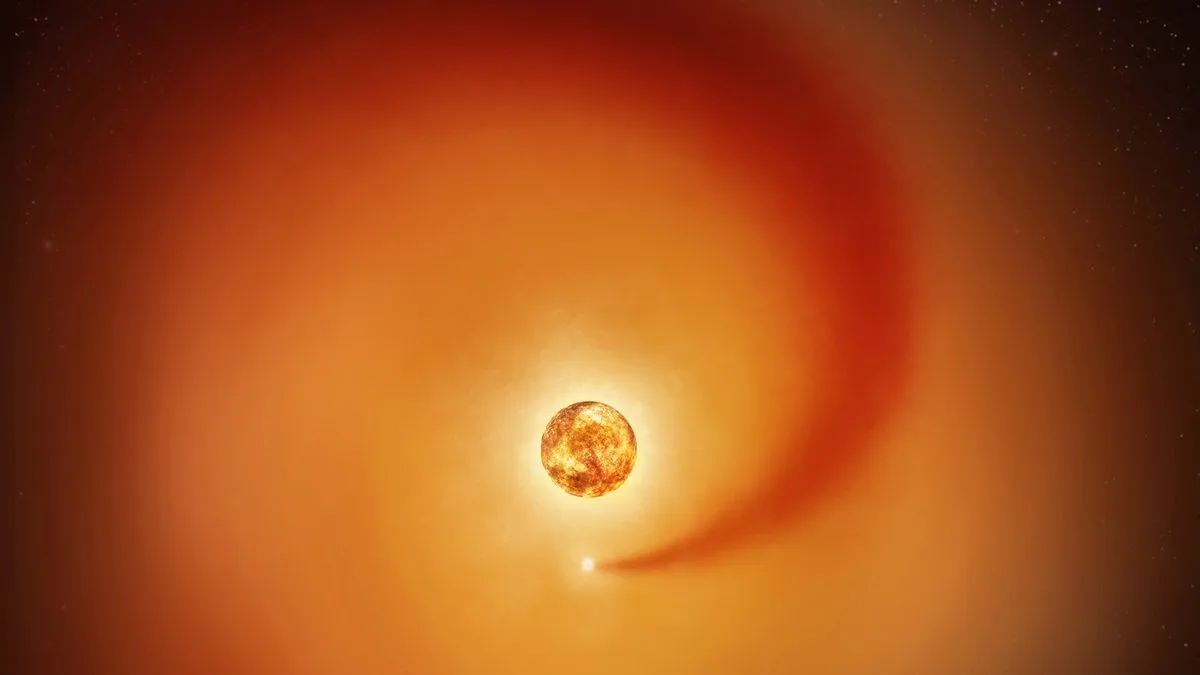
Astronomers have long known that Betelgeuse has an unexplained six-year-long periodic fluctuation in its brightness in addition to its less dramatic 400-day cycle. They suspected the cause was a second star—a “Betel buddy,” if you will—orbiting the supergiant; the system dims when the companion star is behind the supergiant and hidden from our view. Astronomers observing Betelgeuse in 2024 found hints of a second star , and now a paper published in the journal Astronomy and Astrophysics strongly supports its existence. This stellar companion is apparently a luminous star that has three times the mass of the sun but is so close to the far brighter supergiant that its light had been hidden in the glare all this time . Confirming this mystery object’s identity is pretty straightforward: observe Betelgeuse in 2027, half an orbit after than its first detection. If the object appears on the other side of the star from where it was in 2024, it’s a binary companion.
If so, it orbits the red supergiant (now called Betelgeuse A) at a minimum distance of about 1.3 billion kilometers, roughly the distance Saturn is from the sun. Even so, from the perspective of this companion star—Betelgeuse B—the supergiant is so swollen that it occupies half the sky. Red supergiants are awesome beasts.
Despite its mysteries, there is one thing we know for sure about Betelgeuse A: someday it will go supernova in one of the most titanic explosions this universe can generate. We don’t know when, precisely—that’s another mystery. It could be tonight, but most signs point toward it happening more like 100,000 years from now .
This cataclysmic end for the star is inevitable.
5News aggregated this summary from the outlet’s public feed. The full article, with all the context, is on www.scientificamerican.com — the content belongs to Scientific American.