Why Wildlife Photographer of the Year winner used an infrared converted Nikon camera
Wildlife Photographer of the Year 2026 winners announced James Lewin won the Animals in their Environment category He used an infrared converted Nikon Z7 II camera and budget lens for his winning shot This week I attended the press preview of the Wildlife Photographer of the Year 2026 exhibition at the Natural History Museum, London, where I had the opportunity to absorb the winning photos on display and meet many of the photographers who took them, and discuss their work.
As fortune would have it, I got chatting with James Lewin, winner of the Animals in their Environment category, as we waited to get into the venue.
The British photographer lives in Kenya, where he took his winning photo — it's a country I know well, having lived there for years myself, so naturally we hit it off.
We both know the challenges facing outdoor photographers in this region: a sunrise / sunset that's over in minutes, and an all-too-brief period of golden light that's quickly followed by typically harsh, bright sunlight.
Most seasoned photographers focus on this narrow window of best light, leaving most of the rest of the day alone.
However, Lewin took advantage of the harsh light by adopting a niche photography genre: infrared.
It's an unusual approach for wildlife photography, but with Lewin's infrared-converted camera, it's as the 'worst' light kicks in that the fun really begins...
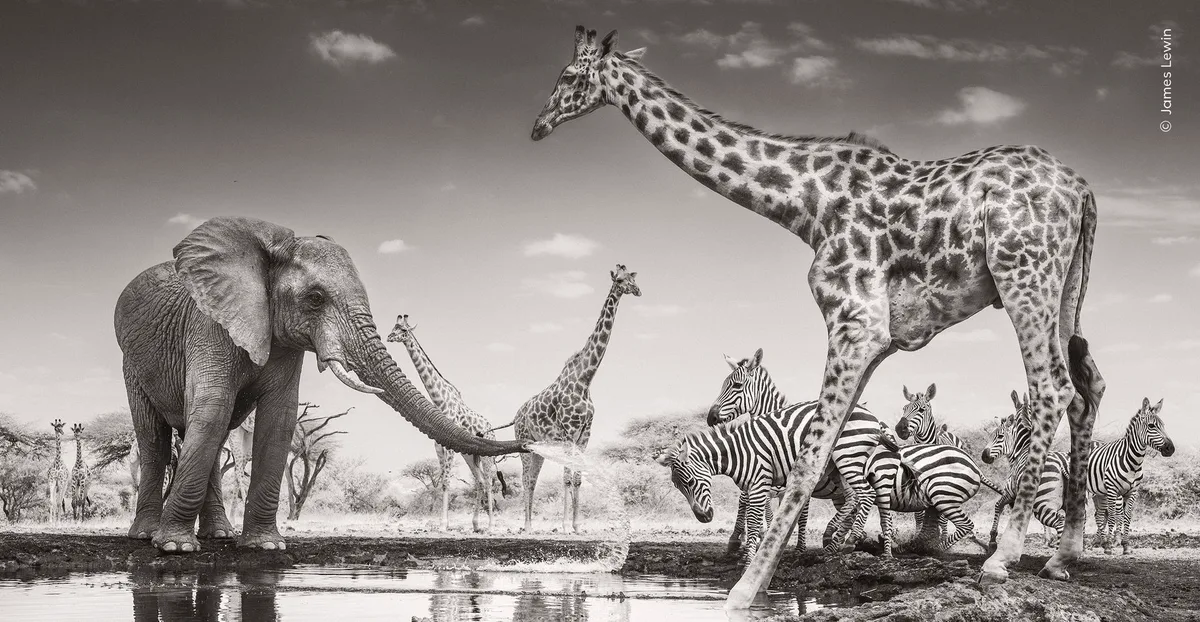
James Lewin, stood next to his winning photograph on display at the contest's exhibition in the Natural History Museum, London (Image credit: Tim Coleman) Why infrared photography? Lewin was observing from a hide near a waterhole in the Chulu Hills in southern Kenya.
During dry season, this location gets incredibly congested, as you can see from Lewin's photo, below.
Working in the middle of the day, under bright sunlight and with strong reflections from the waterhole, his images looking unappealing.
That's when he made the decision to switch to his infrared-converted Nikon Z7 II .
Lewin has had his Z7 II permanently converted, switching the camera sensor's regular filter with a dedicated 720nm infrared filter (monochrome), which accepts part of the spectrum of light that's invisible to the human eye.
"There would have been no image without it [infrared photography]", he told me.
But with it "the skies become more dramatic, the plants reflect infrared light, and you get an otherworldly atmosphere and beautifully soft scene that you cannot produce with a regular camera.
5News aggregated this summary from the outlet’s public feed. The full article, with all the context, is on www.techradar.com — the content belongs to TechRadar.