I couldn't reach Yr Wyddfa's summit because people jumped the queue
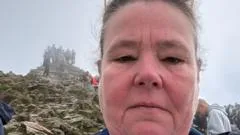
When Helen Pacey and her family booked a trip on the Snowdon Mountain Railway, they were looking forward to touching the summit marker at the top of Yr Wyddfa, also known as Snowdon.
But after spending 30 minutes waiting in a queue at the top of Wales' highest mountain, 58-year-old Helen ran out of time and had to get the return train back down.
"I've had both my hips replaced, so there was no way I could have gone up the rocky side of it," said Helen, from Hull in Yorkshire.
Scores of visitors have climbed Yr Wyddfa this summer, but there have been reports of people waiting more than an hour to reach the mountain's highest point, at 1,085m (3,560ft).
Earlier this week, we reported on arguments breaking out between queue-jumpers and those waiting in line at the top . Dozens of readers subsequently got in touch to share their views on the issue.
One of those who contacted us was Pacey, who hoped to touch the metal plate at the mountain's highest point alongside her husband, sister and brother-in-law.
But when Pacey and her family got off the train on 22 August, they were faced with a long queue.
"It was hectic," she said "There were people just pushing and shoving and running past us and climbing up the rocks to get up."
Pacey said the summit was so crowded that she was surprised nobody fell.
The group had only 30 minutes before their return train and they did not reach the trig point before they had to begin their descent.
"It was quite sad," she said. "It's really disappointing we didn't actually go right to the summit.
"But for me, it's not something I would do again, I just felt it was too dangerous up at the top with the amount of people shoving and pushing."
Pacey said the mountain was "for everybody", not just the "endurance runners and hikers".
"It's not fair that these people that are much fitter than others are just running up the rocks and getting to the top," she said.
5News aggregated this summary from the outlet’s public feed. The full article, with all the context, is on www.bbc.co.uk — the content belongs to BBC News UK.