How do astronauts return from space and survive re-entry? | Explained
Account subscription benefits alongside Premium Stories, Editorials, Opinions and more. Unlock these with Subscription
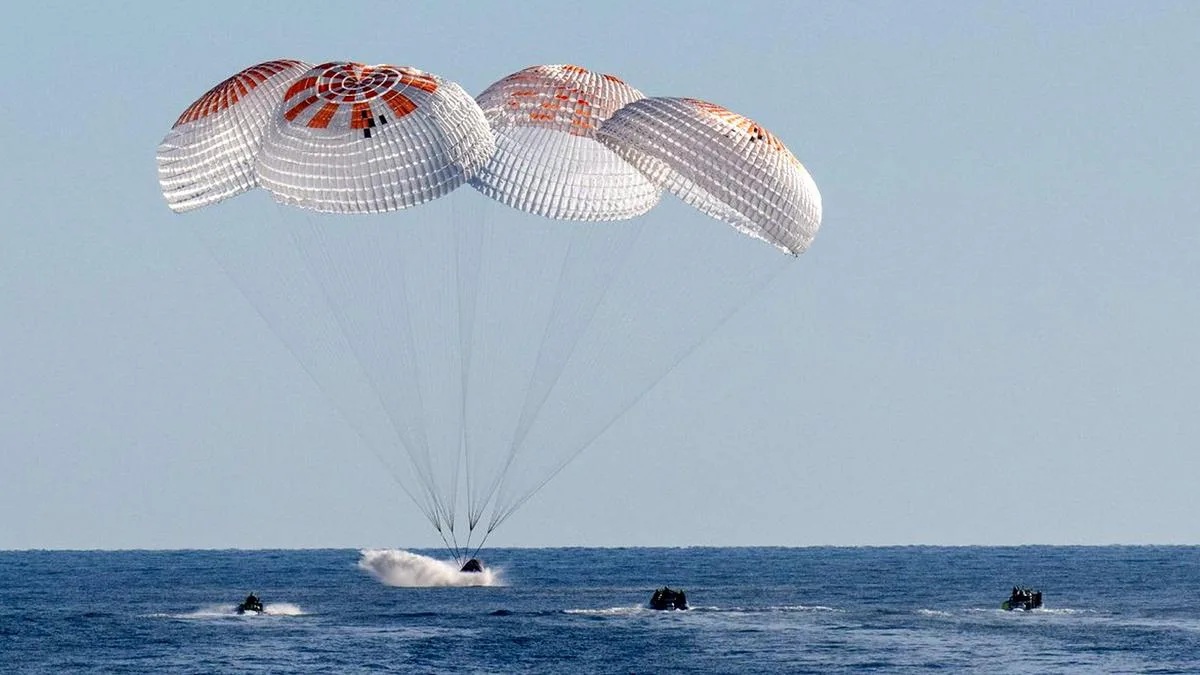
In the lower atmosphere, a returning capsule can still reach hundreds of kilometres per hour, far too fast for a safe landing, so the parachute has to be deployed to reduce the velocity for a soft landing in the sea | Photo Credit: PTI
The ascent of a launch vehicle is a battle against gravity to gain the immense velocity required to stay in orbit — while re-entry is a struggle against the atmosphere to shed that same energy in a systematic way.
Initially, aerospace scientists believed that surviving atmospheric re-entry would be impossible because the massive kinetic energy of an orbiting space capsule would be converted into intense heat energy upon re-entry. The resulting temperatures would be so extreme that they would melt any known structural material. The breakthrough came with the blunt body theory, which proved that if the space capsule’s forebody is rounded with a large radius, it can deflect most of the re-entry heat into the surrounding air rather than being directed into the capsule.
More than 98% energy of a re-entering capsule is dissipated through the atmosphere and converted into heat. The capsule is shielded from this intense thermal environment by its heatshield, which has a robust thermal protection system: it dissipates the heat through either ablation — where the material sacrificially chars and erodes to carry heat away — or thermal insulation, which uses low-conductivity materials to prevent the heat from reaching the capsule’s primary structure.
To return to earth, a space capsule must break its orbit by reducing its velocity. It does this by performing a deorbit burn: turning 180 degrees and firing its engines in the opposite direction of its travel. Since forward speed is what maintains the orbit, losing that speed allows gravity to overcome the capsule’s centrifugal force. The capsule then drops out of its stable circular path and enters a shallow, downward elliptical curve, leading it into the upper atmosphere for re-entry.
The re-entry corridor is a precise atmospheric window that a spacecraft must hit to return safely, balanced between two extremes. If the entry angle is too shallow (the overshoot boundary), the capsule will act like a stone skipping across a pond, bouncing off the atmosphere back into space. Conversely, if the angle is too steep (the undershoot boundary), the capsule will hit the dense air too hard, generating lethal deceleration forces and frictional heat that exceed what the crew and capsule can survive.
A ballistic body behaves like a falling stone: it cannot steer by itself and is slowed only by the air resistance (drag). In contrast, a semi-ballistic body flies at a specific angle, known as the angle of attack.
5News aggregated this summary from the outlet’s public feed. The full article, with all the context, is on www.thehindu.com — the content belongs to The Hindu.