How Noida workers’ protest landed a DU student in jail under NSA
Account subscription benefits alongside Premium Stories, Editorials, Opinions and more. Unlock these with Subscription
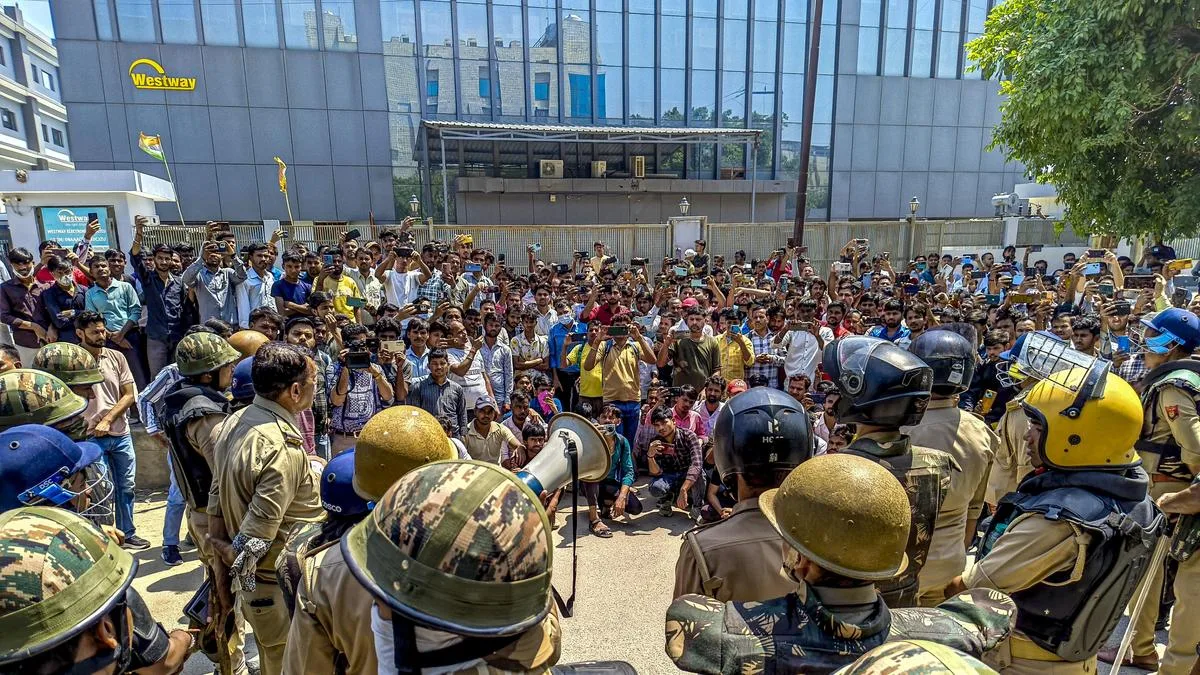
Factory workers stage a protest demanding a hike in wages in Noida, Gautam Buddh Nagar district, Uttar Pradesh, in April 2026. | Photo Credit: PTI
On a hot April afternoon, as the war involving the United States, Israel and Iran pushed several countries to grapple with an oil and gas crisis and rising prices, workers took to the streets in Noida — one of Asia’s major planned industrial areas, with thousands of factories and manufacturing units — demanding an increase in minimum wages as the cost of living continued to rise in India.
The protest was also part of growing labour unrest across the National Capital Region (NCR), coming shortly after workers in neighbouring Haryana secured a significant increase in wages.
The demonstration began with workers raising slogans, skipping tasks and staging demonstrations outside their institutions. However, it took a serious turn on April 13, when the protest turned violent. Vehicles were set on fire, stones were thrown at barricades and police used tear gas to disperse the crowd. In the days that followed, domestic workers also joined the protests, raising their own demands for better wages and working conditions.
The Uttar Pradesh Government responded by approving an increase of around 21% in minimum wages and issuing revised wage rates for different categories of workers by April 18.
The crackdown that followed was wide-reaching, with Noida police filing one FIR, invoking charges related to rioting, arson and attempted murder against activists, workers and even journalists. By the middle of April, more than 300 people linked to the protests had reportedly been arrested.
Akriti Chaudhary, a 25-year-old law student from Delhi University, was arrested by Noida police. She holds a postgraduate degree in history and is linked to the Progressive Artists’ League, contributing articles to Mazdoor Bigul, a Lucknow-based publication focused on workers’ rights and labour struggles.
According to the police chargesheet, she played a key role in “instigating workers toward violent protest”, and they claimed to have electronic and video evidence connecting her to the violence. There were also allegations of “foreign funding involving Ms. Chaudhary and Satyam Verma”, who identifies himself as a journalist.
On May 13 — about a month after Ms. Chaudhary’s arrest — the Uttar Pradesh Police invoked the National Security Act, 1980 (NSA), against her and against Mr. Verma.
The NSA is a preventive-detention law. It allows authorities to detain someone without a regular trial for an extended period if they believe the person’s activities pose a threat to national security or public order. Because it permits detention without a prior conviction, it is considerably more serious than an ordinary criminal charge.
Ms. Chaudhary applied for bail, but it was rejected several times by a sessions court in Surajpur.
5News aggregated this summary from the outlet’s public feed. The full article, with all the context, is on www.thehindu.com — the content belongs to The Hindu - National.