4.46 crore voters in Karnataka draft rolls; 1.07 crore names deleted
Account subscription benefits alongside Premium Stories, Editorials, Opinions and more. Unlock these with Subscription
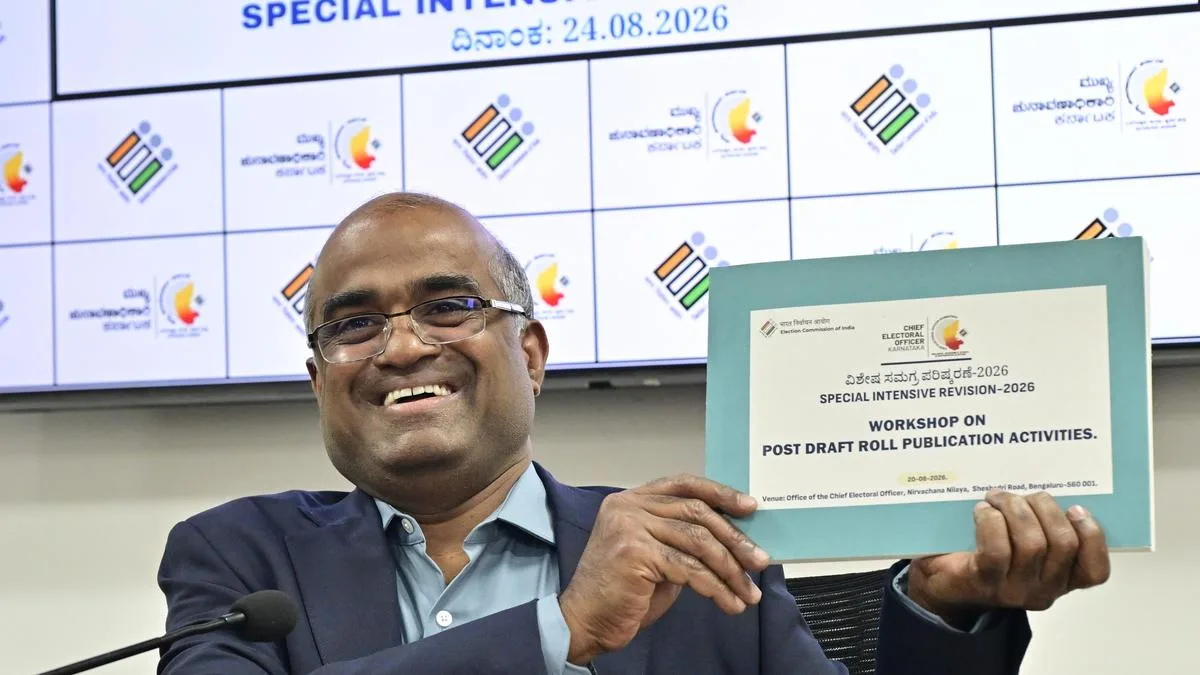
V. Anbu Kumar, Chief Electoral Officer for Karnataka, addressing a press conference regarding the Karnataka SIR (Special Intensive Revision) updates, in Bengaluru on August 24, 2026. | Photo Credit: Murali Kumar K
With the removal of over 1.07 crore names , Karnataka’s electorate shrunk to 4.46 crore voters when the draft electoral rolls were published on Monday as part of the Special Intensive Revision (SIR). An overwhelming number of the missing names were marked ‘absent, shifted, duplicate, dead, and others’ (ASDDO).
Announcing the figures at the end of the enumeration phase, Karnataka Chief Electoral Officer (CEO) V. Anbu Kumar said the electorate comprised over 2.22 crore males, 2.24 crore females, and 2,871 others. Voters can check their names on the CEO’s official website .
The CEO said a special campaign will be conducted in areas reporting high ASDDO numbers, where voters will be assisted in filling Form 6 (for inclusion). The dates for the campaign are yet to be announced by the CEO’s office.
As many as 43.81 lakh notices will be served on voters whose enumeration forms contained logical discrepancies or those who could not be mapped. Notices may also be issued if a complaint is filed against a voter or if the Electoral Registration Officer (ERO) has reason to suspect that a voter is ineligible.
With the enumeration phase ending, voters are likely to face the same problems they encountered with the ASDDO list. Just as people remained unaware that their names were in the ASDDO list until 12 days before the enumeration phase ended, they now have no way of knowing whether they will receive a notice until one is actually served. “We only have numbers on how many people will receive notices, and the names will not be known until the notice is generated,” the CEO said.
However, the entire process — from an ERO generating a notice to it being served — is to be completed within just seven days. This could become a major hurdle, especially for voters living in another district or city while remaining registered in their native constituency, as the voter must attend the hearing in person.
There is, so far, no online option to check whether a person is likely to receive a notice. The CEO reiterated that names will be known only after a notice is generated.
The process has now placed the burden of saving one’s vote squarely on the voter. Unlike the enumeration phase, when Booth Level Officers (BLOs) were instructed to hand over enumeration forms to voters and a family member above the age of 18 could fill them on the voter’s behalf, BLOs, during this stage, can serve notices on anyone available at the address.
5News aggregated this summary from the outlet’s public feed. The full article, with all the context, is on www.thehindu.com — the content belongs to The Hindu - National.