How Sainath Ganuwad’s self-funded Marathi short brings rebellion in the classroom
Account subscription benefits alongside Premium Stories, Editorials, Opinions and more. Unlock these with Subscription
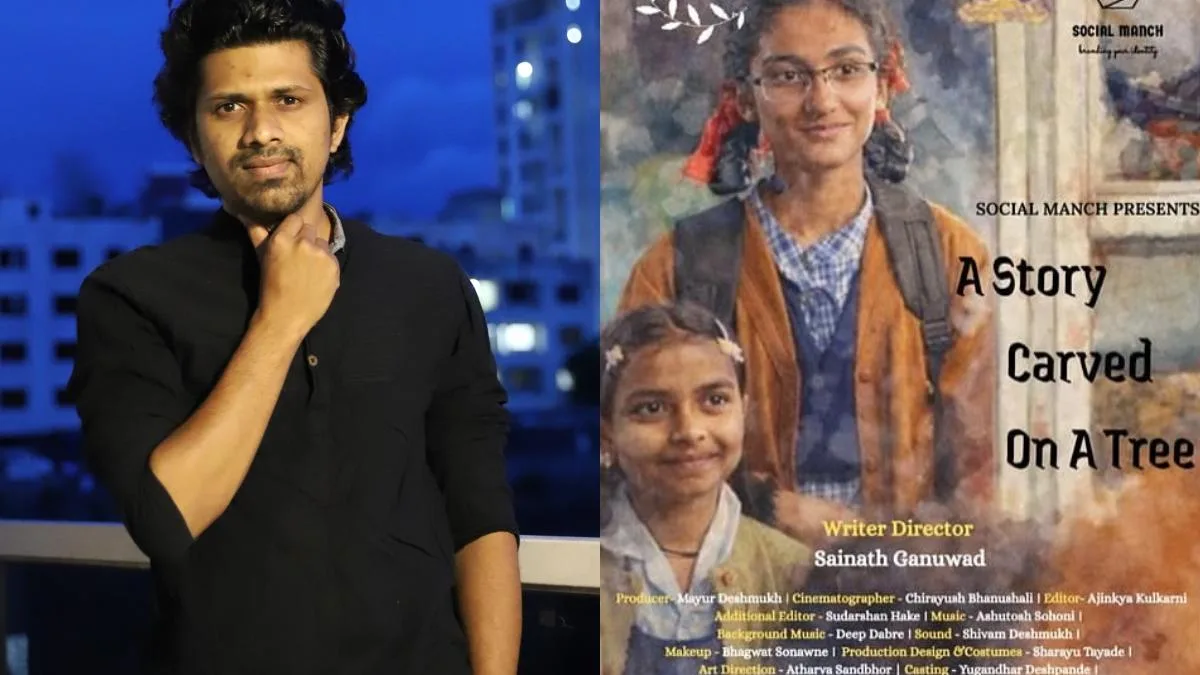
Sainath Ganuwad and the poster of ‘A Story Carved On A Tree’ | Photo Credit: Special Arrangement
In Sainath Ganuwad’s stirring Marathi short Zadavar Korleli Gosht (A Story Carved on A Tree) , caste makes its presence felt in a thoughtful setting. It tells the story of two girls, Nisha and Disha, living in a shanty on the boundaries of a forest, as they navigate muddy roads and rough terrain to reach the school in the heart of a village. When they plead with the village Sarpanch to start a bus service to ease their journey, they are violently chased back into the forest by his son. The oppression is generational, as the film shows Disha dreaming about her grandmother, who attempts to send her a message by carving something on a tree.
“No one has written the stories of our people. That’s why our people wrote their stories on trees and stones. I wanted to bring that perspective into the film,” says Sainath, who has written and directed Zadavar Korleli Gosht .
The film began with a host of scattered images that came to Sainath as he was thinking of a story to submit for a fellowship centred on the generational nature of oppression. “I had this image of a girl travelling via bus and how she dreams of her grandma, whom she has never seen. It was through the process of rewriting that I figured out the back story of the grandmother and how Disha stands up for herself after gaining strength from her ancestors,” Sainath explains.
Sainath, who pursued screenwriting from the Film and Television Institute of India (FTII), has previously co-written Zombivali , the Marathi zombie comedy packed with a socialistic punch. Like in Zadavar Korleli Gosht , politics naturally becomes part of his stories. Sainath says his “progressive worldview” comes from his theatre days. “The plays that I did were very vocal, where the message was didactic. Slowly, with practice, I realised that politics can seep into my work indirectly as well,” Sainath says. “Now, I cannot write something apolitical even if I decide to. Even if I write about love and death, it will become political.”
A still from ‘A Story Carved On A Tree’ | Photo Credit: Special Arrangement
Zadavar Korleli Gosht also blends the thought and spirit of Dr. BR Ambedkar into its aesthetics. The camera stays on his photo at Disha’s home for a few seconds in a scene, and the film even ends with his powerful quote about the importance of education. For Sainath, the connection with Ambedkar is emotional. Growing up in Nanded, Maharashtra, Sainath read Anna Bhau Sathe’s Fakira and Ambedkar’s seminal essay, Waiting for a Visa, like any other books. It was only when he came to study in Pune that he was introduced to radical ideas through discussions with his friends. That’s when he read Ambedkar deeply.
“I had no family in Pune. So, my parents were a bit scared about my safety too. In my lowest times, I was grateful for the statue of Ambedkar in the city. I had no one in the city, but whenever I was in the university, I would feel empowered looking at his statue.
5News aggregated this summary from the outlet’s public feed. The full article, with all the context, is on www.thehindu.com — the content belongs to The Hindu.