Value Trap: A low P/E does not always mean a bargain — 8 factors investors should look at before buying
Value investing means buying a stock or asset that is trading below what an investor believes to be its intrinsic or true value, with the expectation that the valuation gap will eventually narrow.
Investors typically use metrics such as the price-to-earnings (P/E) and price-to-book (P/B) ratios to identify stocks that appear inexpensive.
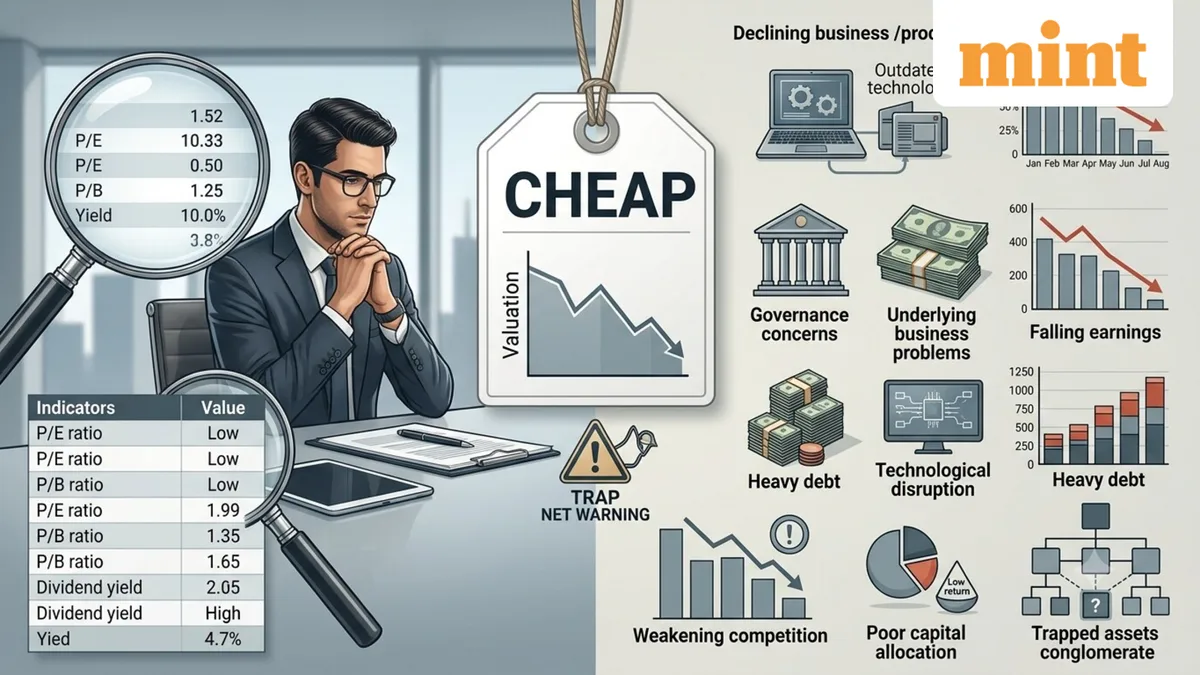
However, a low valuation does not necessarily mean an investment is undervalued. It could be a value trap - a stock that looks cheap because its price or financial ratios are attractive, but whose underlying business continues to deteriorate. In such cases, the expected recovery in valuation may never happen.
The Bank of India Value Fund NFO presentation identifies “eight ways a cheap stock can remain cheap”, warning investors about the risk of value traps. The underlying message, it says, is: “Cheapness without change is a value trap.”
Here are the 8 key factors that can help you identify a stock that appears undervalued but can actually be a value trap .
A stock may look attractive because it has a low P/E and high dividend yield. But investors should check whether the company’s core product or business model is becoming obsolete. If the underlying business is in structural decline, the stock may remain cheap because its earnings potential is falling.
A company may look extremely cheap when its profits are temporarily boosted by favourable industry conditions. For example, a 4x trailing P/E may look attractive, but if these are peak-cycle earnings and profits later fall 60–70% as conditions normalise, the stock may not actually be cheap.
A low P/B ratio can make a stock look inexpensive, but investors should also look at the company’s debt. If net debt is 5–6 times EBITDA, a large part of the company’s assets may effectively be supported by debt, leaving less value for shareholders.
A large asset base does not necessarily mean a company is creating value. Investors should check how efficiently the company uses its capital. If it earns only 5% ROCE against a 12% cost of capital, the business is generating returns below what it costs to finance that capital.
A company may trade at a 50% discount to its peers because of concerns about governance or management quality. Investors should assess whether these concerns are temporary or structural. If they are unlikely to change, the valuation discount may remain for a long time.
A stock may trade below its historical valuation because technology is changing the industry. In this situation, comparing today’s valuation with the company’s past may be misleading if its earlier earnings model is no longer sustainable.
A company may continue to report profits while gradually losing market share, pricing power, and margins. Therefore, the stock can look cheap on current numbers even as its competitive position steadily deteriorates.
A diversified company may own several businesses that appear valuable individually. But if capital remains tied up in low-return subsidiaries or businesses, it may not translate into value for investors.
Disclaimer: This is purely for educational/informational purposes and should not be taken as any sort of investment advice.
5News aggregated this summary from the outlet’s public feed. The full article, with all the context, is on www.livemint.com — the content belongs to LiveMint - Money.