Vijaya Lakshmi Pandit: the lamp of India
Account subscription benefits alongside Premium Stories, Editorials, Opinions and more. Unlock these with Subscription
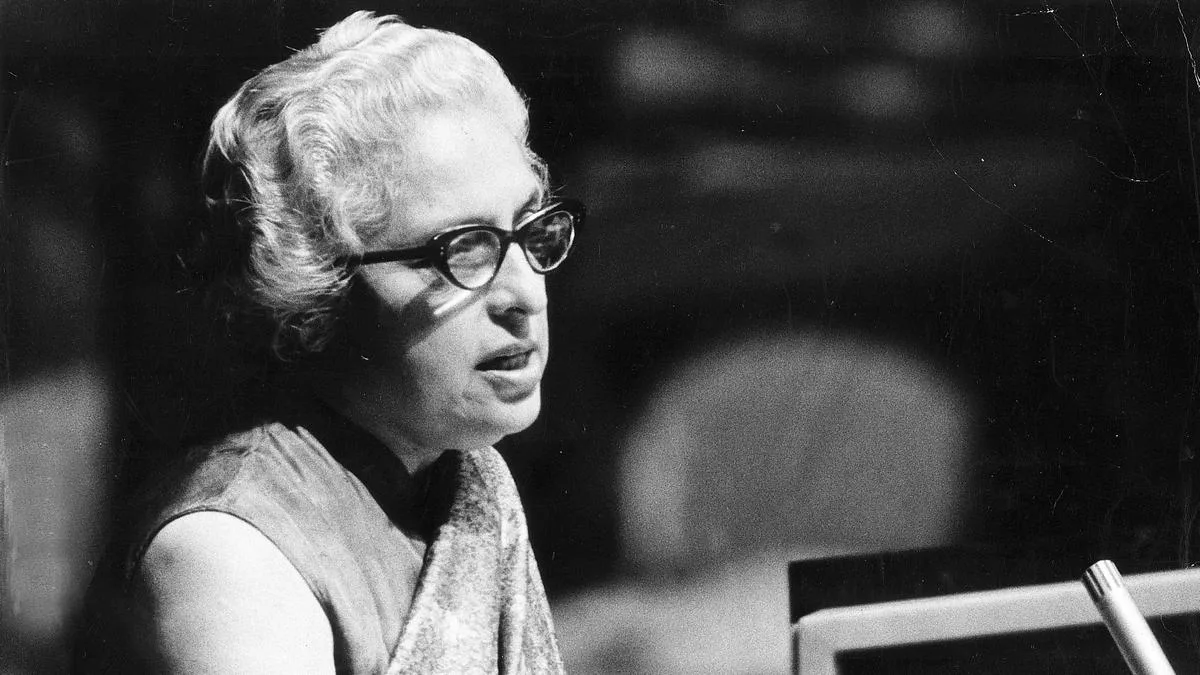
Vijaya Lakshmi Pandit addresses the UN General Assembly in New York on October 11, 1963. | Photo Credit: The Hindu Photo Archives
In the year 1900, in Allahabad, Motilal Nehru and Swaruprani Thussu had a little girl child whom they named Swarup. She was the second child, and her elder brother is quite a familiar name to many — Jawaharlal Nehru, the first Prime Minister of India. Still confused about who we are talking about? This is the story of Vijaya Lakshmi Pandit (born as Swarup Nehru), an Indian freedom fighter, diplomat and the eighth President of the United Nations General Assembly, making her the first woman and the only Indian to have been appointed to this post.
Even though born into a wealthy and influential family, Vijaya Lakshmi Pandit did not get a formal school education. However, her father was a successful Oxford-educated lawyer and staunch Gandhian nationalist.
As a believer that educated women are needed in the ongoing Indian Nationalist movement, he ensured that she was homeschooled by English governesses and tutors from a young age. She thus became quite fluent in English even before Hindi, which later would help her pave her way in the field of International Relations.
It was in 1916 that she attended the Congress Session, which famously took place in Lucknow. Seeing women leaders like Sarojini Naidu and Annie Besant inspired her to be more active in societal and political matters of pre-independent India. Soon after, she started to work with Mahatma Gandhi’s ashram and Young India , a prominent English-language weekly journal published by Mahatma Gandhi from 1919 to 1931.
It was around this time that she got married to Ranjit Sitaram Pandit, a barrister and classical scholar.
In 1936, Vijaya Lakshmi stood for the general elections and became a member of parliament in 1937 for a constituency in Uttar Pradesh. She was then designated the Minister of Local Self-Government and Public Health for a year, becoming the first woman to hold a cabinet position in pre-independent India.
An active participant in the Indian independence movement, she was jailed multiple times throughout these years for participating in protests like the Quit India Movement. She was also actively doing social work, especially during the Bengal famine in the 1940s. In 1946, she was again appointed the Minister of Local Self-Government and Public Health.
Around 1944, her husband Ranjit passed away in Lucknow prison after being arrested for taking part in the Indian Independence movement. This was when she experienced the Indian inheritance law, which did not give any right to a deceased person’s wife or daughters but rather prioritised the closest male relative of the deceased (no matter how far off). She then started campaigning with the All India Women’s Conference to bring changes to these laws.
In 1944, the British Empire faced a conundrum. A recent widow, Vijaya Lakshmi Pandit, had applied for a visa to visit her daughters studying in American colleges.
5News aggregated this summary from the outlet’s public feed. The full article, with all the context, is on www.thehindu.com — the content belongs to The Hindu.