Reintroduction of tigers in Buxa: What it means for conservation | Explained
Account subscription benefits alongside Premium Stories, Editorials, Opinions and more. Unlock these with Subscription
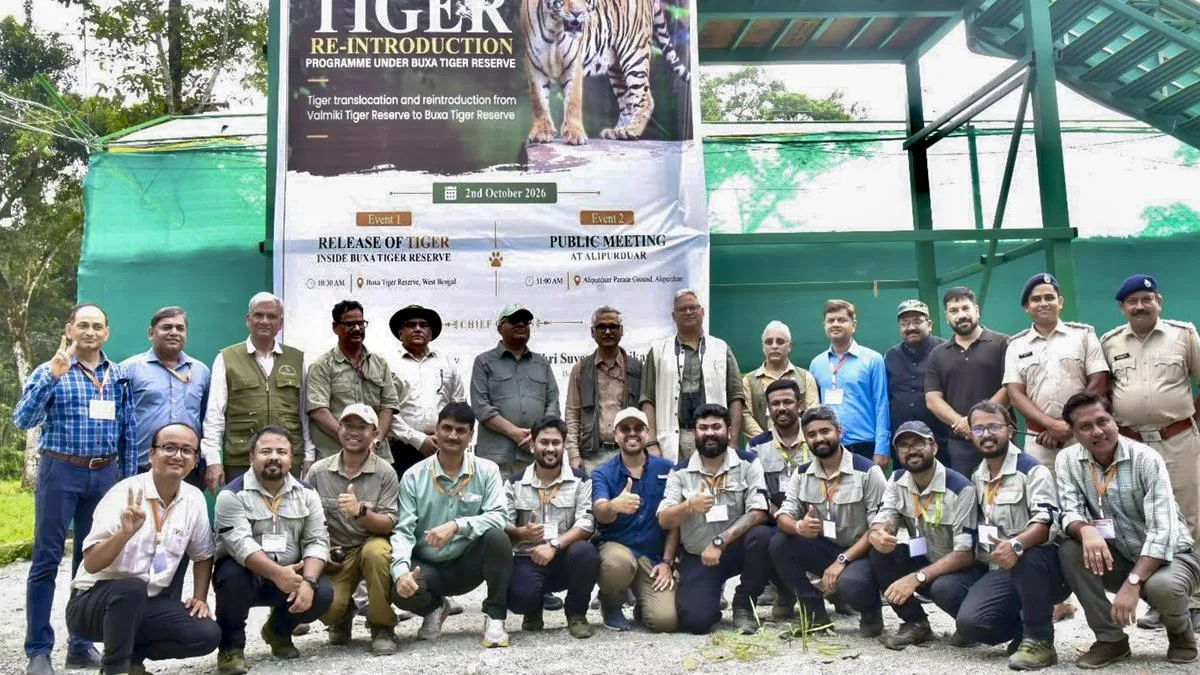
Union Minister Bhupender Yadav and others in a group photograph during the reintroduction of tiger T138 which has been brought from Valmiki Tiger Reserve from Bihar to Buxa. Photo credit: X/byadavbjp via PTI
On October 2, 2026 a three-year-old tigress, T138, was released into the Buxa Tiger Reserve in West Bengal marking the beginning of a phased programme to reintroduce tigers and establish a viable, self-sustaining population in the reserve. Two to three more tigers are likely to be added to the reserve which has not recorded much presence of tigers over the past few years.
The tigress was translocated from Bihar’s Valmiki Tiger Reserve and released in the presence of Union Environment Minister Bhupender Yadav and West Bengal Chief Minister Suvendu Adhikari.
Initially the tigress would be kept in an enclosed area of about 2.3 hectares to allow the animal to acclimatise to its new surroundings before it is released into the wider reserve. T138 would be subject to intensive post-release monitoring using a combination of telemetry, camera trapping and field-based monitoring to assess her movement, adaptation, health and behaviour.
The release of the tigress is not is not merely about bringing tigers back to Buxa but its “objective is to create the conditions in which a tiger population can establish, breed and ultimately become viable and self-sustaining,” PIB said in a statement.
Buxa was declared a tiger reserve in 1983 and is the 15 th tiger reserve in the country. Buxa Tiger Reserve is situated in the Alipurduar Sub-division of Jalpaiguri District, West Bengal.
With an area of 760.87 sq km, the reserve stretches over a length of 50 km from west to east and 35 km from north to south. The reserve has corridor connectivity across the border with the forests of Bhutan in the north, on the east it has linkages with the Kochugaon forests, Manas Tiger Reserve and on the West with the Jaldapara National Park.
One of the reasons for low tiger density has been changes in the habitat due to increasing anthropogenic pressure. “Over the decades, however, habitat degradation and fragmentation, changes in land use and decline in prey availability have affected the ecological conditions required to sustain a resident tiger population. The Reserve subsequently witnessed a prolonged absence of a stable resident tiger population,” a PIB statement said.
The National Tiger Conservation Authority found that there were no tigers at Buxa, Dampa and Palamu tiger reserves it initiated a programme of reintroduction of tigers in 2018, which has resulted in re-introduction of tigers at Buxa. Scientists and forest officials were looking for a similar habitat like Buxa from where the tiger may be brought to the reserve. Bihar’s Valmiki Tiger Reserve which lies in the eastern most part of the Terai Arc Landscape, was considered suitable for tiger augmentation because of the similarities in terrain with Buxa.
West Bengal has a thriving tiger population in the Sundarbans, the only mangrove forest in the world to have tigers.
5News aggregated this summary from the outlet’s public feed. The full article, with all the context, is on www.thehindu.com — the content belongs to The Hindu - Sci-Tech.