Five years after Taliban takeover, life in Afghanistan marred by many struggles
Account subscription benefits alongside Premium Stories, Editorials, Opinions and more. Unlock these with Subscription
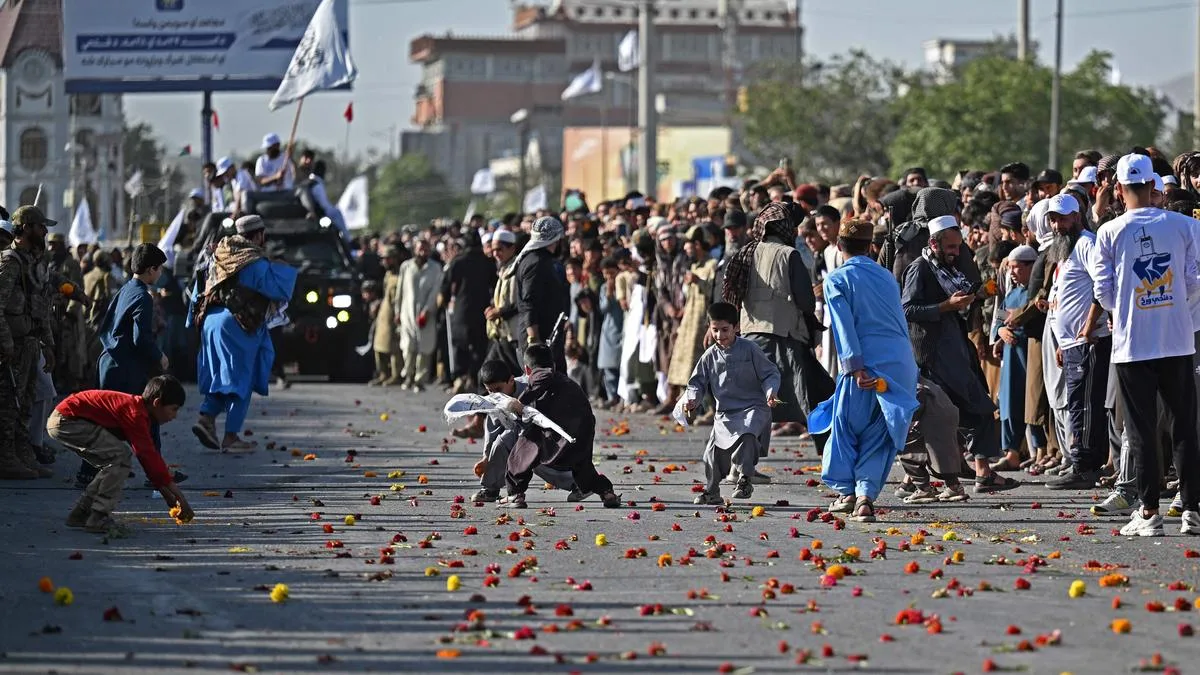
Children collecting flowers showered from a military helicopter during a parade by athletes marking the fifth anniversary of the Taliban government’s return to power in Kabul on August 15, 2026. | Photo Credit: AFP
It has been five years since the Taliban returned to Kabul, bringing an end to the U.S.-led military presence in Afghanistan and the Islamic Republic that had ruled the country for two decades. On August 15, 2021, the Taliban entered the Afghan capital as President Ashraf Ghani fled the country. The collapse of the government marked the end of America’s longest war and the Taliban’s return to power.
So, what has changed since 2021? The most immediate change was the end of the war between the Taliban and the then Afghan government.
The U.S. and NATO completed their military withdrawal in August 2021. Afghan security forces collapsed soon afterwards. The Taliban took control of Kabul and established themselves as the country’s de facto government.
There is now no nationwide armed conflict comparable to the fighting that took place before 2021. The Taliban control Afghanistan’s major government institutions, security forces and borders, and the armed Opposition groups have not been able to mount a significant nationwide challenge.
For many Afghans, the reduction in fighting has meant improved security. Roads that were previously affected by battles and checkpoints are generally more accessible, and the risk of being caught in clashes between the Taliban and government forces has fallen.
The Islamic State-Khorasan Province, or the ISKP, remains active and has carried out attacks against civilians, Taliban officials and foreign nationals. The Taliban have also carried out operations against the group.
There are also growing tensions with Pakistan. The two countries have repeatedly accused each other of allowing militant groups to operate from their territory, while clashes along the border have become more frequent. Pakistan had been an important supporter of the Taliban for years, but since 2021, Islamabad’s concerns over militant attacks and border security have increasingly complicated relations with Kabul.
If the end of the war is one of the biggest changes since 2021, the restrictions on women and girls are another. The situation of women and girls has changed sharply since the Taliban returned to power.
When the Taliban took control in 2021, they said they would respect women’s rights under their interpretation of Islamic law. But restrictions on women have steadily increased .
Girls remain barred from secondary education and higher education. Women have been excluded from many areas of employment and face restrictions on movement and access to public spaces. The restrictions have affected almost every aspect of women’s participation in public life.
The education ban has also created a longer-term problem. Girls who are unable to complete school cannot easily move on to university or professional training.
5News aggregated this summary from the outlet’s public feed. The full article, with all the context, is on www.thehindu.com — the content belongs to The Hindu - International.