CGTN Poll: 90% say Yasukuni Shrine is a 'shrine to war criminals'
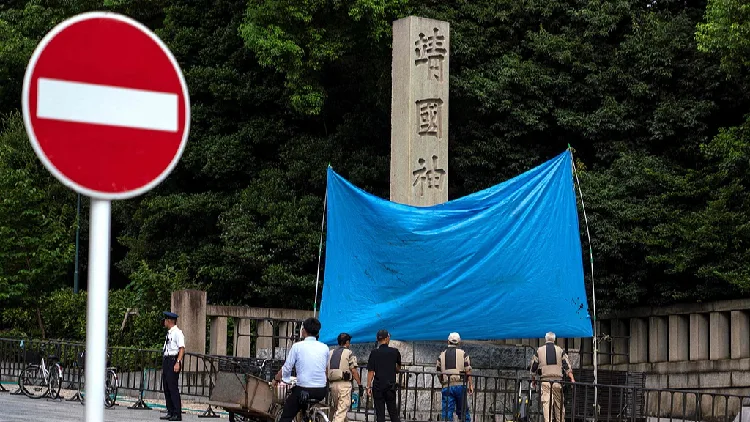
On the opening day of Yasukuni Shrine's autumn festival, Japanese Prime Minister Sanae Takaichi made a ritual offering in her capacity as prime minister.
Japanese Minister of State for Economic and Fiscal Policy Minoru Kiuchi visited the shrine in person, while other senior political figures, including House of Representatives Speaker Eisuke Mori and House of Councillors President Masakazu Sekiguchi, sent offerings of their own.
These moves sparked criticism and opposition both at home and abroad.
An online survey conducted by CGTN across its global platforms found that 90.71% of respondents agreed that international media should use the term "war criminal shrine" more explicitly when reporting on the issue, in order to alert the world to the resurgence of Japanese militarism.
Yasukuni Shrine honors 14 convicted Class-A war criminals responsible for Japan's war of aggression and is widely considered a spiritual tool and symbol of Japanese militarism.
In the survey, 88.53% of respondents agreed that the offerings amounted to an attempt to whitewash Japan's history of aggression and overturn the verdict on its war crimes, while 87.38% said the conduct of Takaichi and other Japanese politicians had deeply offended people in neighboring countries that suffered under Japanese militarism.
Visits and offerings by senior Japanese government figures have drawn criticism from Japan's neighboring countries.
The South Korean government once again expressed "deep disappointment and regret" over repeated offerings and visits to Yasukuni Shrine by Japanese leaders, saying the shrine "glorifies Japan's past wars of aggression and enshrines war criminals." It urged Japanese leaders to face history squarely and demonstrate, through concrete actions, humble reflection on and sincere remorse for the past.
Earlier, Chinese Foreign Ministry spokesperson Mao Ning commented on revelations that the Japanese government had reached an arrangement with the shrine as early as the 1960s concerning the honoring of Class-A war criminals but had kept it from the public.
Mao said the government of the day knew full well how disgraceful such an enshrinement was.
Fearful of the consequences, it deliberately kept the decision-making process secret.
In the survey, 89.22% of respondents believed the Japanese government should heed voices from both the international community and within Japan opposing politicians' visits to Yasukuni Shrine.
Meanwhile, 84.67% described the offerings and visits as an affront to historical justice and a grave provocation against the outcomes of World War II and the post-war international order, warning that they would further strain Japan's relations with countries it once invaded.
此摘要由5News从媒体的公开信息源汇聚而成。 包含完整背景的全文在www.cgtn.com — 内容归CGTN Politics (oficial)所有。