Edmonton looking to improve snow and ice clearing policy
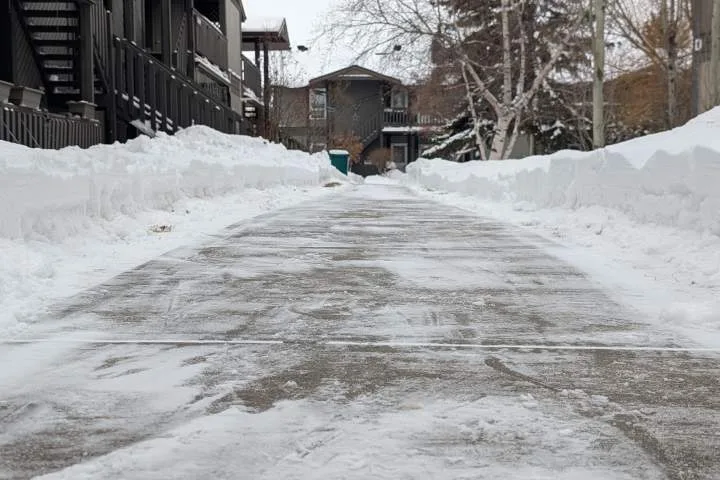
Edmonton’s snow and ice clearing policy was front and centre at the Community and Public Services Committee meeting on Monday.
After receiving massive amounts of snow last winter, the policy is being updated to take accessibility into account when clearing snow and ice from city streets and pathways.
“I think the main takeaways in that service package is that you’re gonna see improvements in every aspect of what we’re doing,” Edmonton Mayor Andrew Knack said.
Among the improvements being proposed is moving residential blading to a monthly basis, if needed.
“Overall, it’s just the optimization of what we do currently,” said Valerie Dacyk, the general supervisor of Edmonton’s snow and ice control program.
“We’ve been working with our fleet counterparts to make sure that the equipment that we need is up and available and where we need it when the snow falls.”
“(They) would allow for speedier snow clearing on even the Priority 1 and 2 roads and active pathways, so it helps with accessibility, it helps with just the movement of people throughout our city and the safety of people throughout our city.”
While it has been discussed , there are no plans currently to re-introduce the effective but controversial calcium chloride chemical solution.
The anti-icing agent was used on arterial and collector roads during a pilot project in 2017 and 2018, but stopped using the de-icing agent in 2019 after increased concerns about damage to vehicles, concrete and infrastructure.
The solution was applied in a thin layer once per snowfall and designed to prevent snow from sticking to the pavement.
It has a lower freezing point than sodium chloride — salt — making it easier for crews to remove snow from roads.
“When it was tested, it did actually make our streets safer — there was clear data that showed that,” Knack said. “But we’ve also heard overwhelmingly from Edmontonians, time and time again — they don’t want this.”
While the province has been using calcium chloride on Anthony Henday Drive for years, the ring road is often dry because high vehicle speeds blow snow off the road — whereas lower speeds on city streets can lead to wet accumulation of calcium chloride on vehicles, which then creep into vehicle parts.
Edmontonian and chemical engineer Arthur Potts addressed the committee, expressing his opposition to calcium chloride. He argued the chemical stays wet for an extended period of time and leads to corrosion on vehicles and roads.
5News aggregated this summary from the outlet’s public feed. The full article, with all the context, is on globalnews.ca — the content belongs to Global News.