London is famous for its great trees. More than 70% are at risk due to climate change, research finds
In the middle of a heat wave and severe drought this summer, Divya Hariramani was pruning a plum tree in south London when she noticed something wrong with one of the tree's branches.
The branch was beginning to split completely from the tree. The workers at Mitcham Community Orchard told her it was because the fruit tree was stressed.
"Because of the heat essentially. Like, when the trees can't provide enough water to its parts and like some parts will just drop," said Hariramani, who documents fruit trees and the people who tend to them across the city on a social media account called Fruity Walks .
While London’s stone architecture may be more famous to some tourists, the 2,000-year-old city is also renowned for its mature urban forest, which has been called the largest in the world.
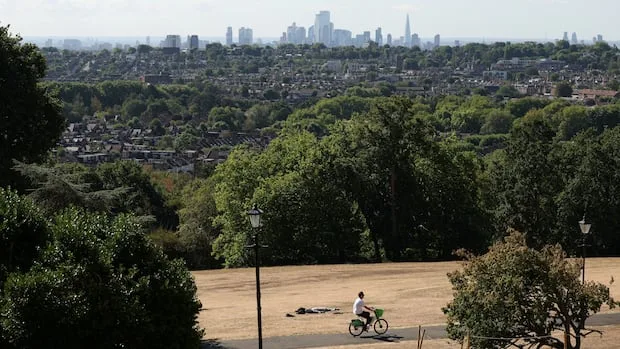
This year has proven difficult for the normally lush canopy, though, as five successive heat waves and a serious lack of rain have strained plants and wildlife.
And it’s projected to get much worse for the city’s eight million trees.
By the end of the century, according to a recent report from Royal Botanic Gardens Kew forecasting the vulnerability of London’s urban forest, some 73 per cent of the city’s trees could be at risk of dying due to climate change.
The Kew Gardens tree collections and arboriculture team worked with the Greater London Authority to assess a sample of over a million public trees and found that 62 per cent of them already have "low suitability" to the climate conditions that can be expected by 2090 without action to reduce emissions. On top of that, nearly 11 per cent are “vulnerable."
It’s not just a future problem. In 2022, 400 of Kew's 11,000 trees died amid extreme heat and drought conditions. The gardens have left the skeleton of one red oak standing, and painted it red as a symbol of what climate change is already doing to London's trees.
Kew highlighted the findings and unveiled the red tree ahead of Climate Action Week in June, when Britain and Europe were already in the throes of a second heat wave. By August, there had been two more and a major drought was declared in much of England and Wales. Virtually no rain fell in July, resulting in the driest July on record in Britain.
Britain's 'exceptionally serious' drought tests a country famous for its rain
Farmers lost crops, warned of food shortages and had to dip into winter feed reserves for cattle. Wildfires in parts of the country prompted an emergency cellphone alert in August. In the city, park grass turned yellow and brittle; tree branches and leaves looked droopier than usual. In some places, trees lost their leaves altogether, giving an autumnal look to the ground in the middle of summer.
The week in June when Kew publicized its report, Hariramani, in an ironic twist of fate, had to cancel a group walk she had organized in light of Climate Action Week due to the heat.
"Literally one of the most important walks in a way, for such an important situation and we couldn't even do it," said Hariramani, whose day job is in sustainable design.
5News aggregated this summary from the outlet’s public feed. The full article, with all the context, is on www.cbc.ca — the content belongs to CBC World.