Researchers say whale entanglements on B.C.'s coast continue to be a concern
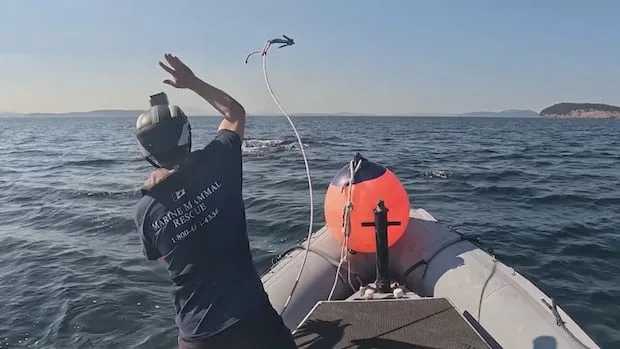
Marine mammal rescuers on Vancouver Island say it's been another busy summer for whale entanglements.
Paul Cottrell, marine mammal co-ordinator with Fisheries and Oceans Canada, said his team has been responding to an average of one to two entanglements a week for the last two months — on track with similar numbers from last year — in addition to several necropsies.
The most recent call was last week — the third time his team had been activated in just under two weeks.
This time it was a humpback whale calf spotted near the south coast of Vancouver Island , accompanied by its mother, wrapped up in over 100 metres of rope.
Cottrell said his team tracked the gear and was able to identify that the calf had been towing the rope since July 5 when it was reported missing from B.C.'s central coast.
His team spent seven hours freeing the calf, working with U.S. counterparts.
"Every animal is extremely important, so saving that calf was amazing, and just felt so good for the team to get out and be able to help that animal," he said.
Before that, there were two calls in two days. His team spent a day and a half disentangling a whale named Wiggins for the second time in a year near French Creek on the eastern coast of Vancouver Island before driving to the central Island and the Alberni Inlet on a second call.
It's something he says is becoming all too frequent, with no signs of entanglement rates dropping.
"We've never had so many humpbacks in inshore waters in British Columbia, which is a fantastic story — the humpback comeback — but unfortunately we're seeing an overlap with inshore fishing gear," he said.
Jackie Hildering, a researcher and educator with the Marine Education and Research Society (MERS), says an increase in conservation efforts has led to what she calls a "second chance" with humpback whales, which were hunted to the brink of extinction.
Whales are dying in B.C. waters. Here's how 2 groups are trying to save them
She said 50 per cent of whales she's photographed through her research have shown signs of being previously entangled, and that could be an underestimate on what the numbers really are.
She says disentanglements make good headlines, but are not a solution. In her research, she says it's unclear how many whales actually survive long term after being disentangled.
5News aggregated this summary from the outlet’s public feed. The full article, with all the context, is on www.cbc.ca — the content belongs to CBC Technology.