They own 2 excavators in Gaza and can't keep up with demand as families dig for remains
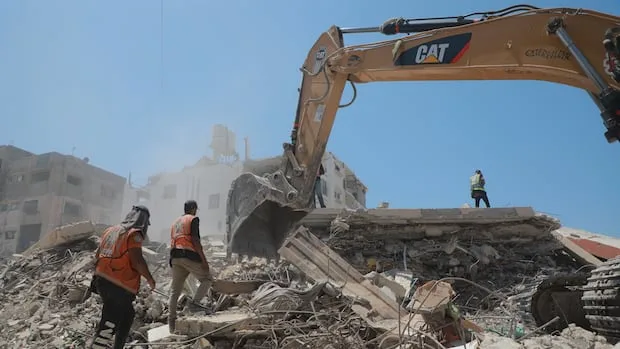
In the heart of Gaza City, several members of the Al-Drimli family dig for the remains of their friend and neighbour in the rubble of their former home, using only shovels, buckets, a wheelbarrow and their hands.
It's the middle of the day on Monday and the sun's rays are strong. The men work in silence, their heads covered by orange towels or the hoods of sweatshirts. The sounds of shovels clanging in rubble and the buzz of an electric saw fill the air.
The men fill the dusty wheelbarrow with rubble and wheel it to a nearby pile — it barely puts a dent in the mounds of broken cinder block and metal rebar remaining from the six-storey residential building that was hit by an airstrike in November 2023.
The Al-Drimli family had already recovered the remains of their loved ones at the site and is now looking for a neighbour who was sheltering with them when a strike destroyed the building.
The Gaza Health Ministry estimates that there are between 8,000 and 10,000 bodies still under the rubble almost three years after the start of the war between Israel and Hamas.
In Gaza City, a funeral for 112 family members takes place 3 years after their deaths
"We work with our hands because the cost of equipment today is very expensive and unavailable," Ayman Al-Drimli told CBC News freelance videographer Mohamed El Saife.
Officials and heavy equipment operators in Gaza say there are currently only about a dozen barely functioning excavators in the strip. They say the machines, which were frequently targeted by strikes during the war, are difficult to maintain under current conditions, which include a lack of parts for repair as well as oil and fuel shortages.
Samir Sabra and his son, Uday Sabra, run two excavators in the Gaza Strip. He says the oil alone needed to run one excavator costs at least 2,500 shekels (about $1,175 Cdn) — not a price he can easily afford.
"We can't run the equipment like this," he told CBC on Monday. "There is no maintenance, no equipment and no spare parts."
Later that day, his son was at a different site just off the main road in Gaza City digging for remains with members of the Palestinian Civil Defence, a volunteer organization of first responders who visit strike sites to search for survivors and recover bodies.
"People call us every day," Uday said, noting he and his father can't keep up with the demand for their services. "There isn't enough equipment for the work because there are so many martyrs under the rubble."
'I woke up and I had lost the baby': Miscarriages in Gaza spike amid harsh conditions, UN report finds
"The amount of damage and destruction in this country, one machine or two machines won't do anything."
5News aggregated this summary from the outlet’s public feed. The full article, with all the context, is on www.cbc.ca — the content belongs to CBC News.